Where Is the VIN Number on a Car? 7 Places to Look
Where is the VIN number on a car? Lower driver-side windshield and driver door jamb, plus title, insurance card and frame. Spots for cars, bikes and trailers.

Co-Founder & CTO
Saurabh is a technology specialist with deep expertise in AI, full-stack development and scalable platform architecture. He built vindecode.pro from the ground up, including the decoder itself: VIN and chassis number rules, maker-specific conventions and the NHTSA vPIC integration. He leads product development and technical strategy, and writes our guides on how VINs work.
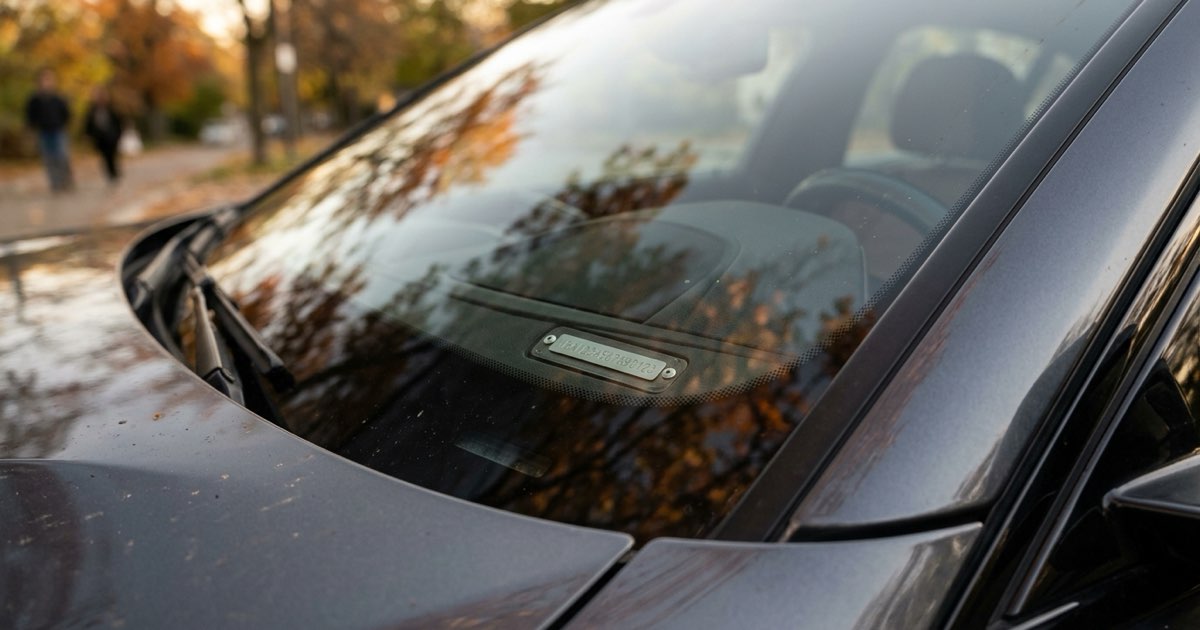
The VIN number on a car is on a small plate at the lower driver-side corner of the dashboard, visible through the windshield, and on the certification label on the driver door jamb. It is also printed on the title, registration and insurance card, and stamped on the frame of most trucks, motorcycles and trailers.
The VIN (vehicle identification number) is the 17-character code that identifies one vehicle and no other. You need it to get an insurance quote, register a car, check recalls, order parts or run a history report, and comparing the VIN in each location is one of the best ways to catch a problem car.
This guide lists every common VIN location for cars, trucks, motorcycles and trailers, with the federal rules behind them. Once you have it, paste it into our free VIN decoder to see the make, model, engine, plant and recalls.
Quick answer: the two places every car has a VIN
| Location | What you see | Required by |
|---|---|---|
| Lower driver-side windshield | VIN plate on the dash, read from outside | 49 CFR 565 |
| Driver door jamb | Certification label with VIN and build month | 49 CFR 567 |
| Title and registration | Printed VIN | State law |
| Insurance card | Printed VIN | Your insurer |
If you only check one, use the windshield. If you are buying, check both the windshield and the door, then compare them with the title.
1. Lower driver-side windshield
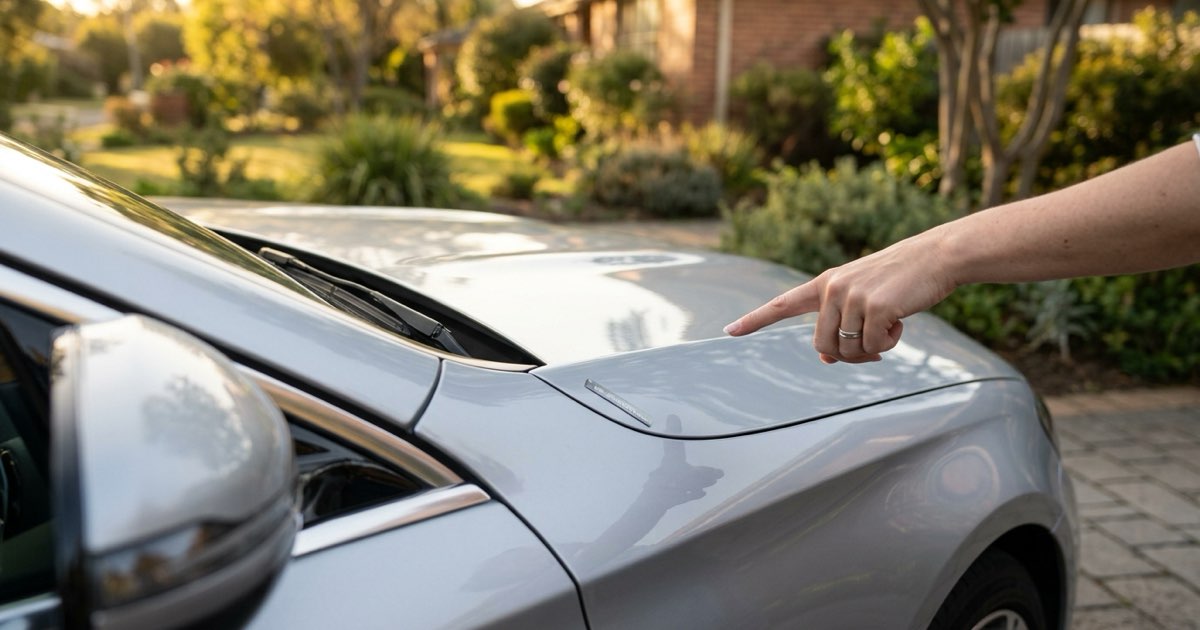
Stand outside the car at the driver side and look through the windshield where it meets the dashboard. You will see a small metal or plastic plate with the 17 characters, often with a barcode next to it.
This location is not a coincidence. Under 49 CFR Part 565, passenger cars, multipurpose vehicles (SUVs and vans) and trucks with a gross vehicle weight rating of 10,000 lb or less must have the VIN inside the passenger compartment, near the left windshield pillar, readable through the glass without moving any part of the vehicle. That is why police officers and DMV inspectors can check it from the street.
Tips:
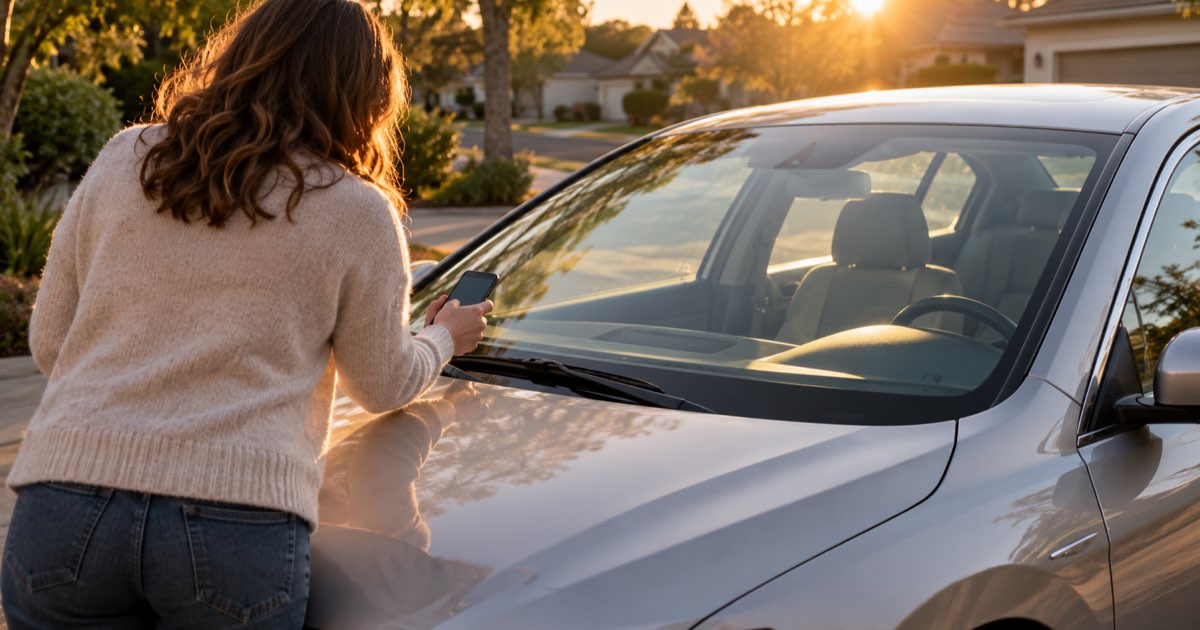
- Glare: shade the glass with your hand or take a phone photo at an angle and zoom in.
- Dark tint strips or dash covers: a dash mat can hide the plate. Lift the edge if you are allowed to.
- Damage: the plate should be fastened securely with clean rivets. Scratched, loose, glued or re-riveted plates deserve a closer look.
2. Driver door jamb certification label
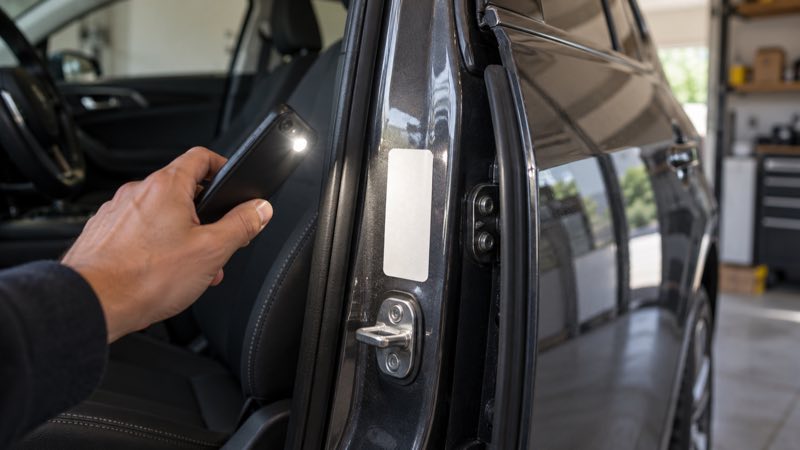
Open the driver door and look at the edge of the door or the pillar it closes against (the B-pillar). You will find a white or silver certification label. Under 49 CFR Part 567, the label goes on the hinge pillar, the door-latch post, or the door edge that meets the latch post, next to the driver's seat.
The label carries more than the VIN:
- The manufacturer's name
- The month and year of manufacture
- Gross vehicle weight rating (GVWR) and gross axle weight ratings
- A statement that the vehicle meets federal safety standards
- The VIN
- On many brands, paint and trim codes, and sometimes the axle ratio
The build date matters because the VIN does not encode it. Position 10 is the model year, which can differ from the build date by several months. Our manufacturing date guide explains the difference.
3–5. Title, registration and insurance card
If the car is not in front of you, the paperwork is the easiest source:
- Certificate of title. The VIN is printed near the top, next to the year, make and body type.
- Registration card. Usually in the glove box. Most states print the full VIN.
- Insurance card or policy declarations page. Your insurer lists the VIN for each covered vehicle, and most insurance apps show it.
Loan contracts, purchase agreements and dealer service invoices also carry it. Many automakers show it in their connected-car apps, such as FordPass, myChevrolet, the Tesla app and MySubaru.
When buying, never rely on the paperwork alone. The seller's title must match the car itself, character for character. A VIN typed into an online listing is the least reliable source of all, because typos and copied VINs are common.
6–7. Frame, engine and body parts
- Frame. Most body-on-frame pickups and SUVs have the VIN stamped on a frame rail, often on the driver side near the front or rear wheel. Rust, undercoating and mud can hide it, so bring a flashlight and a rag.
- Engine, transmission and body panels. Many engines carry a partial VIN stamp. Under the federal theft prevention standard, 49 CFR Part 541, vehicle lines that NHTSA classes as high-theft must also have the VIN marked on major parts such as the engine, transmission, doors, hood, fenders, bumpers, quarter panels and trunk lid. Replacement parts carry an "R" and the manufacturer's logo instead, so a panel without the VIN can simply mean it was repaired.
Inspectors use these hidden markings to identify vehicles whose dash plate has been swapped. You will not usually need them, but a car with every original panel label removed is worth asking about.
Where the VIN is on trucks, motorcycles and trailers
| Vehicle | Where to look first | Backup locations |
|---|---|---|
| Pickup truck | Windshield, driver door jamb | Frame rail, title |
| Heavy truck (over 10,000 lb GVWR) | Door jamb label | Frame rail, cab plate. The windshield plate is not required. |
| Motorcycle | Steering head (frame neck) | Frame label, engine case stamp |
| Trailer | Tongue or front frame rail | Certification label on the front left side |
| RV or motorhome | Windshield and door, like a truck | Chassis frame; the house part may have a separate label |
On motorcycles, turn the handlebars fully to one side to read the steering-head stamp. Our Harley-Davidson VIN decoder shows where Harley puts it, and the engine-case stamp that should match. For other brands, our motorcycle VIN decoder guide covers Yamaha, Kawasaki and ATVs, and the trailer VIN decoder guide explains what a trailer's 17 characters mean.
VIN location by brand
Every brand follows the same federal rules, so the windshield and door are always the first two places. Brand guides go deeper on the extras:
- Ford and Lincoln: frame stamp on F-Series trucks, and the VIN in the FordPass app. See the Ford VIN decoder.
- Chevrolet and GM: on older models, the Service Parts Identification label in the glove box or center console lists the VIN with the factory option codes; many newer models use a QR code on the driver door-pillar label instead. See the Chevy VIN decoder.
- Tesla: the touchscreen shows the VIN under Controls, then Software. See the Tesla VIN decoder.
- Subaru: the MySubaru account shows the VIN for registered cars. See the Subaru VIN decoder.
- Harley-Davidson: the steering head and engine case. See the Harley-Davidson VIN decoder.
- Toyota and Lexus: the windshield plate and door-jamb label like every car, but Toyota puts the engine code in the 5th character, not the 8th. See the Toyota VIN decoder.
- Jeep: the same two places, plus model-line and engine codes that changed with each generation. See the Jeep VIN decoder.
- BMW and Mercedes-Benz: German-built cars start with W, while US-built SUVs start with 4 or 5. See the BMW VIN decoder and the Mercedes VIN decoder.
Whichever brand you have, the NHTSA VIN decoder reads the same federal data our decoder uses, and the VIN check digit tells you whether you copied the VIN correctly before you rely on it.
What to do if the VINs do not match
All copies of the VIN should be identical. If they are not:
- Recheck for misreads.
8andB,5andS,0andD, and1and7are easy to confuse. VINs never use I, O or Q, so an "O" is always a zero. - Run the check digit. Position 9 is calculated from the other 16 characters. Our decoder recalculates it, so a typo usually shows up immediately. Our guide to how to read a VIN shows the math.
- Ask for an explanation. A replacement door can lack the original label, and a replaced engine will not match. Those repairs are legal but should be documented.
- Walk away from a mismatched dash plate or title. A windshield VIN that does not match the title, a plate with fresh rivets or a ground-down frame stamp are signs of a cloned or stolen car. Many states require a physical VIN inspection by law enforcement or the DMV before such a vehicle can be titled. Florida's process is a good example; see our Florida VIN check guide.
Once the VINs match, run the theft and salvage check in our NICB VIN check guide, then decode the VIN to confirm the year, engine and plant are what the seller described. Our guides to car specs by VIN, the Ford engine code and the Chevy engine code by VIN show what the decode can confirm.
Frequently asked questions
Where is the VIN number on a car?
Look through the windshield at the lower driver-side corner of the dashboard. A small plate there shows the 17-character VIN. The same VIN is printed on the certification label on the driver door jamb and on the title, registration and insurance card.
Is the VIN on the driver door?
Yes. Federal rules require a certification label on the driver door edge, door-latch post or hinge pillar. It shows the VIN, the manufacturer, the month and year of manufacture and the weight ratings.
Where is the VIN on a motorcycle?
On most motorcycles the VIN is stamped on the steering head, the frame tube behind the front forks. Turn the handlebars to one side and use a flashlight. Many bikes also have a label on the frame that repeats it.
Can I find my VIN without going to the car?
Yes. Your title, registration card, insurance card or policy, loan documents and dealer service invoices all show the VIN. Connected-car apps from many brands display it too.
What if the VIN on the dashboard does not match the door?
Stop and get an explanation in writing before you buy. A replaced door can lose its label legitimately, but a dash plate that does not match the title is a classic sign of a stolen or rebuilt vehicle. Ask your state DMV or a law enforcement VIN inspection to confirm.
Sources & official references
- 49 CFR Part 565: Vehicle Identification Number requirementsecfr.gov
Federal VIN format and windshield location rule
- 49 CFR Part 567: Certificationecfr.gov
Door-jamb certification label contents and placement
- 49 CFR Part 541: Federal Motor Vehicle Theft Prevention Standardecfr.gov
Parts marking on high-theft vehicle lines
- NHTSA vPIC VIN decoding APIvpic.nhtsa.dot.gov
Manufacturer-supplied VIN decoding data