
RC Check Online: Official Vehicle Registration Guide
Decode the chassis number here, then verify registration on the official VAHAN, Parivahan and DigiLocker services.
An RC check online helps you compare a vehicle's registration particulars with the car, bike or scooter in front of you. For official records, use VAHAN, mParivahan, DigiLocker or the RC. vindecode.pro is not connected to VAHAN. We decode VIN/chassis structure and use NHTSA vPIC data where available. We don't look up registration, ownership, accident, insurance, theft, finance, odometer, service or claim records.
Start with the physical vehicle, then compare the registration result, RC and factory identifier.
Find the chassis and engine number before an RC check
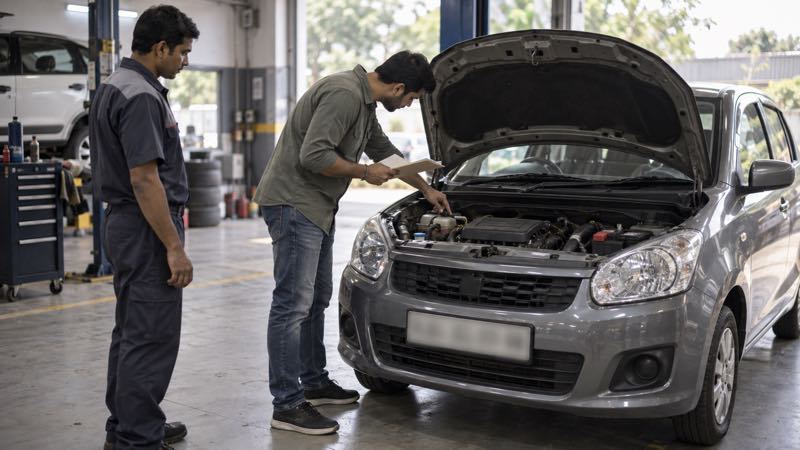
On a car, look first through the lower corner of the windscreen. A VIN may also be on a door-jamb label, in the engine bay, or stamped into the body or frame. NHTSA's VIN-location guidance shows common windscreen and document locations for US-market vehicles. On a motorcycle, start at the steering-head tube or frame. Some scooters carry the frame number under the seat or elsewhere on the frame. The exact location is maker- and model-specific, so use the owner's manual or ask an authorised workshop to show you the original marking. Don't scrape, sand, repaint, or use solvent on it.
The same numbers may appear on the RC, insurance policy, sales papers and Form 22. Form 23, the official RC format, has fields for the maker, manufacture month/year, chassis number, engine or motor number, fuel and vehicle class. The smart-card format also includes those vehicle particulars. See the official Form 23 and Form 23A.
| Where to look | What to compare | Practical check |
|---|---|---|
| Vehicle's original stamp or VIN plate | Entire chassis/VIN, character for character | Photograph the surrounding area with permission. Don't rely on a cropped seller photo. |
| Engine block or motor casing | Engine/motor number | Ask the owner to show it in good light. A replacement should have paperwork and the right record update. |
| RC book or smart card | Registration number, maker, class, fuel, manufacture date, chassis and engine/motor number | Read each character, not just the last five. |
| Insurance and purchase papers | Registration number and chassis/VIN | Treat an inconsistency as something to resolve, not a minor formatting issue. |
What the RC fields mean in practice
The RC describes the registered vehicle. It isn't a condition report. Use it to ask sensible questions, then compare the answers with the vehicle.
| RC field | Why it matters | Cross-check it against |
|---|---|---|
| Registration number and date | Identifies the record and when it entered the register | The number plate and official result. Registration date isn't the manufacturing date. |
| Maker, model, vehicle class and body type | Helps identify a car, motorcycle or transport vehicle as recorded | Badges and body type, while allowing for trim changes or repaired panels. |
| Fuel and emission norm | Should fit the vehicle and its papers | Fuel flap, engine type, emissions documentation and the official record. |
| Manufacture month/year | Helps put the vehicle's paperwork in sequence | Form 22 and the RC, not just the seller's claimed model year. |
| Chassis number | The strongest document-to-vehicle identity check | The original stamp, the complete VIN and a chassis number check. |
| Engine or motor number | Links the recorded power unit to the vehicle | The physical engine/motor marking and evidence of a properly recorded replacement. |
| Hypothecation and validity fields | Can affect a sale or transfer | The official result, lender release documents and current insurance/PUCC papers where relevant. |
Illustrative example, not a real VIN: A seller shows ABC12D3E4F5G67890 on an RC and the same 17 characters on a stamped area under the bonnet. Our decoder returns a maker-level result and some available factory attributes. The buyer then checks the registration number on the official service: the maker, fuel and chassis entry should be consistent with the vehicle and RC. That is encouraging, but it still doesn't prove who owns it, whether it was crashed, or whether insurance claims exist. Those are separate records and checks.
ISO 3779 sets out VIN content and structure for road vehicles, but it doesn't make every character a universal trim code. NHTSA says its vPIC API decodes manufacturer-submitted VIN information. A blank field is a reason not to guess. For a wider used-vehicle review, use the vehicle history check guide.
Choose the right official RC route
These services have different jobs. This is a summary, not a walkthrough. For the full official process, read the RC check online guide and the VAHAN and Parivahan RC guide.
| Route | Best for | What to expect |
|---|---|---|
| VAHAN / Parivahan Know Your Vehicle Details | Checking basic public registration particulars by vehicle number | The official service lists items such as vehicle status, vehicle class, fuel, emission norm, registration date, insurance and PUCC validity, and whether it is hypothecated. Public access is limited and some owner data is masked. |
| mParivahan | Accessing your own RC details on a phone | MoRTH's policy says users can access their own complete RC status and can create a virtual RC through the VAHAN/SARATHI databases. |
| DigiLocker | Keeping an issued digital RC in your own account | DigiLocker fetches the MoRTH record into Issued Documents when the account and issuer data match. It is for the rightful holder, not a public ownership search. |
| RC book or smart card / RTO | Reading the certificate itself or resolving a record problem | Use the physical certificate to compare fields. Go to the registering authority for a correction, duplicate, transfer or formal record issue. |
MoRTH's National Transport Repository data-sharing policy describes the limited public field set. MoRTH also says documents available through DigiLocker or mParivahan are legally recognised electronic records. Read its official advisory. For a digital copy, use the DigiLocker RC download guide. For the document itself, see RC book vs smart card RC.
Red flags worth pausing for
- A physical mismatch: One digit off, uneven characters, fresh paint, grinding marks, or a loose-looking plate. Get an in-person check.
- A person mismatch: The seller won't involve the registered owner or explain hypothecation. Don't pay while release and transfer papers are missing.
- A record mismatch: Vehicle class, fuel, maker or manufacture timing doesn't fit. It needs a documented correction before transfer.
- A paper trail gap: An engine replacement, duplicate RC, interstate move or major repair has no invoices or RTO paperwork.
- A rushed purchase: The seller discourages a daytime inspection, test ride or official check.
For a two-wheeler, frame markings can be awkward to see and a test ride matters. The bike RC check online guide covers buyer-focused checks without turning the landing page into another step-by-step portal guide.
Common RC check mistakes and fixes
- Mixing up
0andO, or1andI: Copy the number from the stamp twice, separately, before entering it. If a character is unclear, get the maker or RTO to inspect it. - Using only the last five chassis digits: Some official tasks use a suffix for validation, but a document comparison needs the complete number.
- Treating model year as registration year: Compare the RC's manufacture month/year, Form 22 and registration date as separate facts.
- Assuming a valid-insurance field is claim history: It only helps confirm the displayed policy validity. It can't tell you the vehicle's accident or claim history.
- Letting a decoder stand in for an RC search: Our tool checks VIN/chassis structure and available vPIC data. It cannot query VAHAN, ownership, registration, accident or insurance records.
After the RC check: next steps
If the physical marks, RC and official result agree, arrange a road test, independent inspection and transfer process with the registered owner. Keep copies of the documents and any lender release or correction paperwork. If anything differs, pause the purchase until the responsible party resolves it in writing.
Use this RC check guide for official-record context, then run the vehicle's full number through the decoder above. For an Indian buyer, that is a better check than either source alone.
Official sources
Where to find the VIN on your car
Standing next to the car? Tap a spot. Check at least two of them. They should match exactly.
Look through the windshield at the lower corner in front of the steering wheel. A metal tag is riveted to the dash. It's the easiest spot to read from outside the car, and zooming in with your phone camera helps in bright sun.
Open the driver door and look at the B-pillar or the edge of the door. The safety certification sticker lists the VIN, often with a barcode you can scan with this site on Android Chrome.
Pop the hood and check the firewall, the front of the engine block or the radiator support. The location varies by maker. Older cars and many trucks have it stamped here.
On trucks, trailers and motorcycles the VIN is often stamped on the frame rail, near a rear wheel well, on a trailer tongue or on the steering head of a motorcycle.

Buying used? Run this five-minute VIN check
Most used-car scams leave a trace in the VIN. Do these before any money changes hands.
- Match all three VINsThe dashboard plate, the door-jamb sticker and the title must be identical. Scratched rivets or a relabeled sticker are red flags.
- Decode and compare to the listingYear, trim and engine should match what the seller claims. A "V6" listing that decodes to a 4-cylinder is a deal-breaker.
- Check the check digitAn invalid check digit on a 1981+ vehicle means a typo, a grey import or a tampered VIN.
- Look up open recallsFree on NHTSA.gov. Dealers repair recalls at no cost, but you should know about them first.
- Run theft and history checksNICB's VINCheck is free for theft and total-loss records. A paid history report adds accidents, title brands and mileage.
Questions, answered
Check an Indian vehicle RC online using VAHAN, mParivahan or DigiLocker. Compare the chassis and engine number with documents before buying or transferring.
Is vindecode.pro connected to VAHAN or mParivahan?
No. vindecode.pro does not query VAHAN, mParivahan, RTO, ownership, insurance, accident or registration databases. It decodes VIN/chassis structure and uses available NHTSA vPIC factory data. Use the official government services or the RC for registration particulars.
Can an RC check show the registered owner's full name?
Public vehicle-detail access is intentionally limited: MoRTH's National Transport Repository policy lists masked owner information among the public RC fields. The rightful holder can access fuller information through mParivahan or DigiLocker after authentication. A buyer should verify documents with the registered owner.
Can I use a DigiLocker or mParivahan RC instead of a physical card?
Yes, when the RC is available through the official DigiLocker or mParivahan platform. MoRTH's 2018 advisory says those electronic records are legally recognised at par with the original documents. It does not mean that a screenshot, a downloaded seller image or an unverified PDF has the same status.
Why does DigiLocker say my RC details do not match?
Re-enter the RC details exactly and check that the name in Aadhaar matches the vehicle-registration record. DigiLocker says a fetch can also fail where the RC record is not available in the National Register. Contact the registering authority or use the official support route rather than trying repeated variations of someone else's details.
Can I check RC status with only a chassis number?
Not as a public RC lookup. Use the registration number on the official vehicle-details service. A chassis decoder can help compare the factory identifier with the vehicle and paperwork, but it cannot reveal registration status or the registered owner from the chassis number alone.
What should I do if the chassis number on the RC differs from the vehicle?
Pause the purchase or transfer. Do not accept a verbal explanation or alter the stamp. Ask the registered owner to have the mismatch checked by the registering authority or an authorised workshop, and retain written correction or replacement-engine paperwork before proceeding.