Bike RC Check Online: A Used-Buyer Guide
Bike RC check online, step by step: compare VAHAN details, the frame stamp, loan status and transfer forms before buying a used motorcycle or scooter.

Co-Founder & COO
Ambika brings 12 years of project management and technical operations experience. She runs the publishing workflow at vindecode.pro, from research and source checks to review and publication, and keeps our guides accurate and up to date as official rules change.
For a bike RC check online, enter the registration number in the official Know Your Vehicle Details service or mParivahan, then compare its result with the motorcycle or scooter and the original RC in front of you. Before you pay for a used two-wheeler, inspect the frame stamp, check whether a financier is still recorded and make sure the registered owner joins the transfer process.
Start with the official RC check guide within the first minutes of a viewing, and use the VIN decoder only as a format cross-check after you can see the physical frame number. A VIN decoder cannot confirm ownership, loan closure or a VAHAN registration record.
How to Check a Bike RC Online
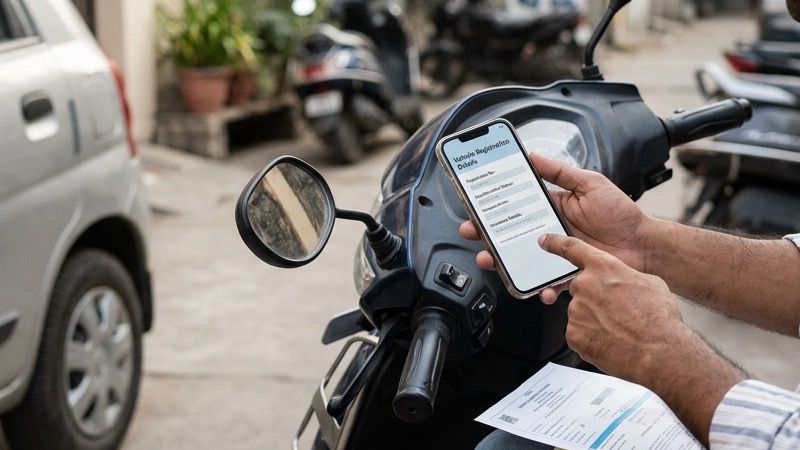
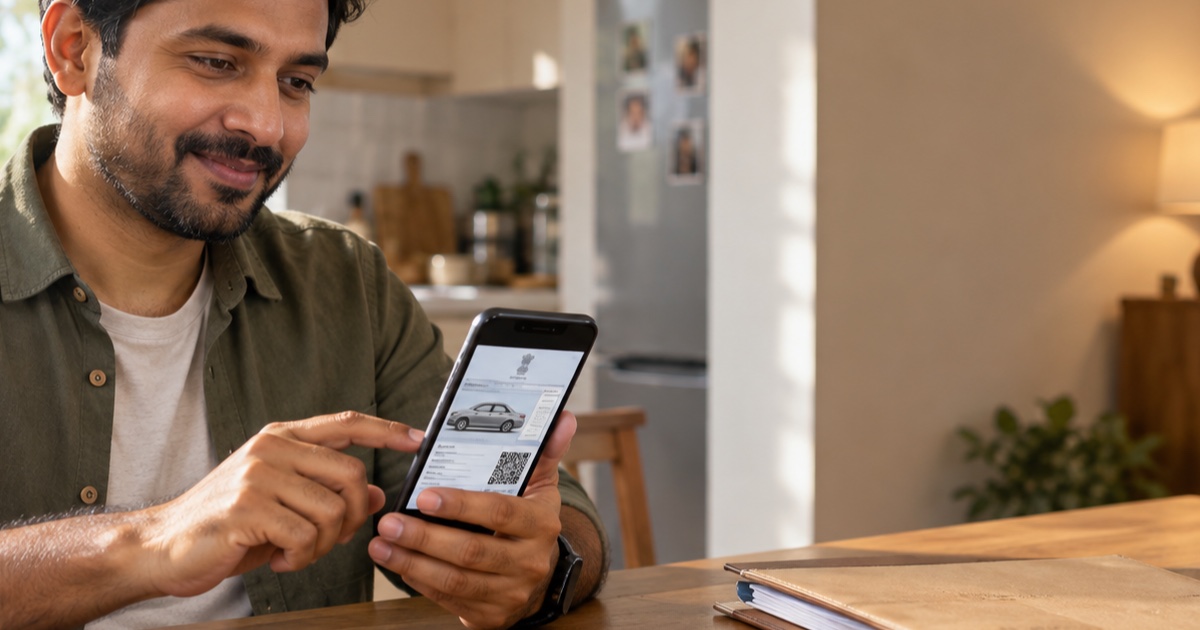
Open Parivahan’s licence and registration details page, choose Know Your Vehicle Details, and enter the registration number in the required format. The site may ask you to sign in and complete a captcha. mParivahan is the official mobile alternative.
Do this before a test ride. Record the returned vehicle facts, then compare them with the listing and bike: maker, model, fuel, vehicle class, registration date, registering authority and any visible chassis or engine suffix. A result that says a different manufacturer, fuel type or class is not a typo to ignore. Stop and ask to see the original RC.
Illustrative example: a listing says DL3SCD2468 is a petrol scooter. If the result indicates another maker, a motorcycle or a different fuel, do not try nearby plate combinations. Ask the seller to resolve it before you continue.
The broader RC status guide explains public lookup, mParivahan and issued DigiLocker records. For an owner’s document, see how to download an RC from DigiLocker.
Read the Result Like a Two-Wheeler Buyer
The public result is a screening tool, not an ownership certificate. Use it at the seller’s address, where you can compare documents and metal rather than trust a forwarded screenshot.
| Field or status | What to compare | What to do if it differs |
|---|---|---|
| Maker / model / fuel / class | Tank or body badges, engine type, RC and sale invoice | Pause. A different maker or fuel type needs an explanation and original documents. |
| Registration date / registering authority | RC and the seller’s claim about state history | For another-state bikes, ask about the NOC and transfer route before a token payment. |
| Chassis and engine details | Original frame and engine stamps | Match every available character. A masked suffix is still useful when it agrees. |
| Hypothecation | Financier NOC and termination paperwork | Do not assume a loan is cleared because the seller says EMI payments ended. |
| Insurance / PUCC | Current certificate from the issuer | Ask for the live policy or certificate. A listing screenshot is not enough. |
Meet the person named on the RC. A buyer who takes only keys, a photocopy and a broker receipt can still be left with an RC in somebody else’s name.
Where to Find the Bike or Scooter Frame Number
Motorcycle and scooter locations are model-specific. Check the owner’s manual, inspect the original stamp, then compare it with the RC. A generic video cannot prove the location for every model.
| Vehicle type | Common area to inspect | Practical access tip |
|---|---|---|
| Standard motorcycle / commuter bike | Steering-head tube or headstock, near the front fork stem | Turn the handlebars left and use a flashlight. Do not scratch paint to expose the stamp. |
| Motorcycle with body panels | Frame near the steering head or behind a removable cover | Ask the seller to remove only normal access panels. Don’t dismantle a bike at a roadside meeting. |
| Step-through scooter | Frame under the seat or near the rear frame section | Lift the seat and look at the owner’s manual before assuming a steering-head location. |
| Electric scooter | Chassis/frame location named in the manual; the drive unit may not have an engine number | Compare the RC chassis identifier and ask the maker’s authorised centre if the location is unclear. |
Some modern Indian bikes carry a 17-character VIN. Hero’s Xpulse 200T 4V manual, for example, shows one on the right steering-head tube. That is a model-specific example, not a rule for every two-wheeler.
MBLAA12BC3D456789 is illustrative only, not a real chassis record. Do not decide manufacture date or ownership from one character; use the RC and maker documentation. The manufacturing-date guide covers that separate check, and our guide to bike manufacturing date by chassis number shows what a two-wheeler frame number can and cannot tell you.
Inspect the Stamp Before a Test Ride
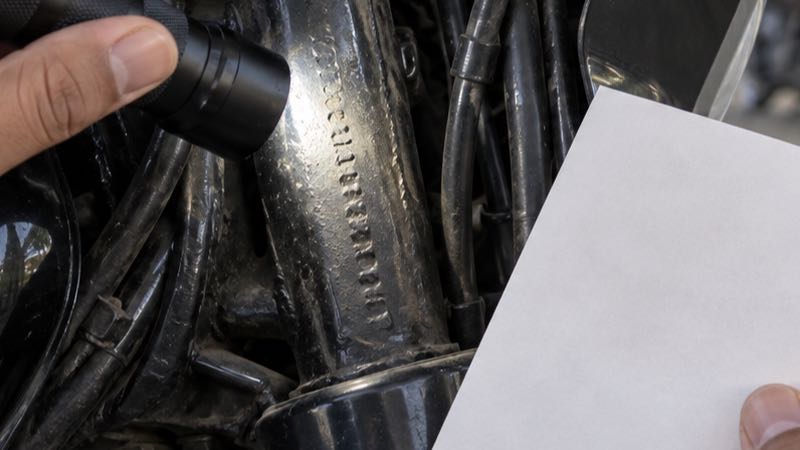
Ask the seller to point to the original stamped metal, not a loose label, pencil rubbing or photograph. Use daylight and a torch, clean only loose dust with a dry cloth, and read left to right. Take a clear photo of the surrounding frame with permission, not only a close crop of the characters.
Look for ground, welded, filled, drilled or freshly painted metal around the stamp. Uneven depth, crooked spacing, sanding marks or mismatched rivets are reasons to stop. They do not prove theft, but require examination by the registering authority, insurer and, where appropriate, police.
Check the engine number if it is on the RC. It is commonly on the crankcase; do not confuse a casting number with an engine serial. The RC check by chassis-number guide explains the limit of a chassis comparison.
Loans, Challans and Documents
An active hypothecation entry means a financier remains in the RC. A “loan closed” SMS is not enough. Ask for the lender’s NOC or closure document and termination evidence. Form 35 is the official notice for ending a hire-purchase, lease or hypothecation agreement.
Also check the official Parivahan eChallan service with the bike’s registration details. If a seller says they will clear a pending notice later, hold payment until the live result updates.
Bring these items together before money changes hands:
- Original RC or the recorded owner’s Issued Documents RC in DigiLocker.
- Seller and registered-owner identity check, where they are different people.
- Current insurance and PUCC documents, plus any lender closure evidence.
- Both frame and engine numbers matched against the RC where those fields are available.
- A written sale record that names the vehicle and a transfer submission plan.
Transfer Forms and Handover Steps
For a normal sale, Form 29 is the transferor’s notice and Form 30 is the transfer application/report. For a same-state vehicle, Parivahan says the transferee applies in Form 30 within 14 days. An outside-state vehicle has a different 45-day period and extra documents.
Use this practical order:
- Run the online check before meeting, but do not send a large token from that screen alone.
- Meet the recorded owner, inspect the original frame stamp and compare the RC, insurance and hypothecation entry.
- Complete the applicable Forms 29 and 30 with the correct vehicle details. Keep signed copies and the submission acknowledgement.
- Pay the balance only when documents and loan-clearance conditions are met. Follow status until the RC changes.
A broker can help with paperwork, but a broker receipt is not a substitute for an application acknowledgement or a completed transfer.
Used-Bike Red Flags and Next Actions
| Red flag | Why it matters | Next action |
|---|---|---|
| Seller will not show the frame stamp | You cannot match the physical bike to the RC. | Walk away until the recorded owner permits an in-person inspection. |
| RC, plate and physical bike disagree | The vehicle may be wrongly described or have a record problem. | Stop payment and ask the registering authority to resolve it. |
| Loan entry is still active | A financier’s interest may remain recorded. | Obtain lender clearance and complete the Form 35 process. |
| Only a photo or photocopy of the RC is available | You cannot assess the current issuer-sourced document or original. | Meet the recorded owner with the original or their issued DigiLocker RC. |
| Transfer is “already applied” but no acknowledgement exists | The bike may remain in the seller’s name. | Ask for the official acknowledgement and track its status. |
The sensible used-bike check is a chain: official result, original stamp, real owner, current documents and traceable transfer. If one link breaks, pause the deal.
Frequently asked questions
Can I check a bike RC online with only the registration number?
Yes. Use the official Parivahan Know Your Vehicle Details service or mParivahan for a public registration-number cross-check. It is not proof that the person selling the bike has completed an ownership transfer.
Where is the chassis number on a motorcycle or scooter?
Many motorcycles have it on the steering-head tube, while scooter locations can be under the seat or on another frame section. The exact location is model-specific, so use that vehicle’s official owner’s manual or an authorised service centre.
Does every bike have a 17-character VIN?
No. Many newer models use 17-character VINs, but Indian manufacturer formats vary. Count the actual frame stamp and compare it exactly with the RC rather than applying a car VIN chart to every bike.
Can I buy a used bike with hypothecation still on the RC?
Pause the purchase until the seller obtains lender clearance and completes the hypothecation-termination process with the registering authority. Form 35 is the official notice for termination of a hire-purchase, lease or hypothecation agreement.
How quickly should a normal used-bike transfer be filed?
For a vehicle registered in the same state, Parivahan says the transferee applies in Form 30 within 14 days of transfer. A vehicle registered outside the state has a different timeline and additional documents.
Sources & official references
- Parivahan Sewa: licence and registration detailsparivahan.gov.in
Official route to Know Your Vehicle Details and registration services.
- Parivahan Sewa: transfer of ownershipmparivahan.parivahan.gov.in
Official transfer guidance for Forms 29 and 30, including same-state and outside-state timelines.
- Parivahan Form 29parivahan.gov.in
Official Notice of Transfer of Ownership form.
- Parivahan download formsparivahan.gov.in
Official list of Forms 29, 30 and 35.
- Hero MotoCorp Xpulse 200T 4V owner manualheromotocorp.com
Manufacturer manual showing a 17-character VIN stamped on the steering-head tube for this model.
- Parivahan eChallanechallan.parivahan.gov.in
Official national eChallan service.