RC Check by Chassis Number: What Is Actually Possible
Can you check RC details by chassis number? Understand official Parivahan lookup limits, match the stamp to an RC and handle missing plates safely in India.

Co-Founder & CTO
Saurabh is a technology specialist with deep expertise in AI, full-stack development and scalable platform architecture. He built vindecode.pro from the ground up, including the decoder itself: VIN and chassis number rules, maker-specific conventions and the NHTSA vPIC integration. He leads product development and technical strategy, and writes our guides on how VINs work.
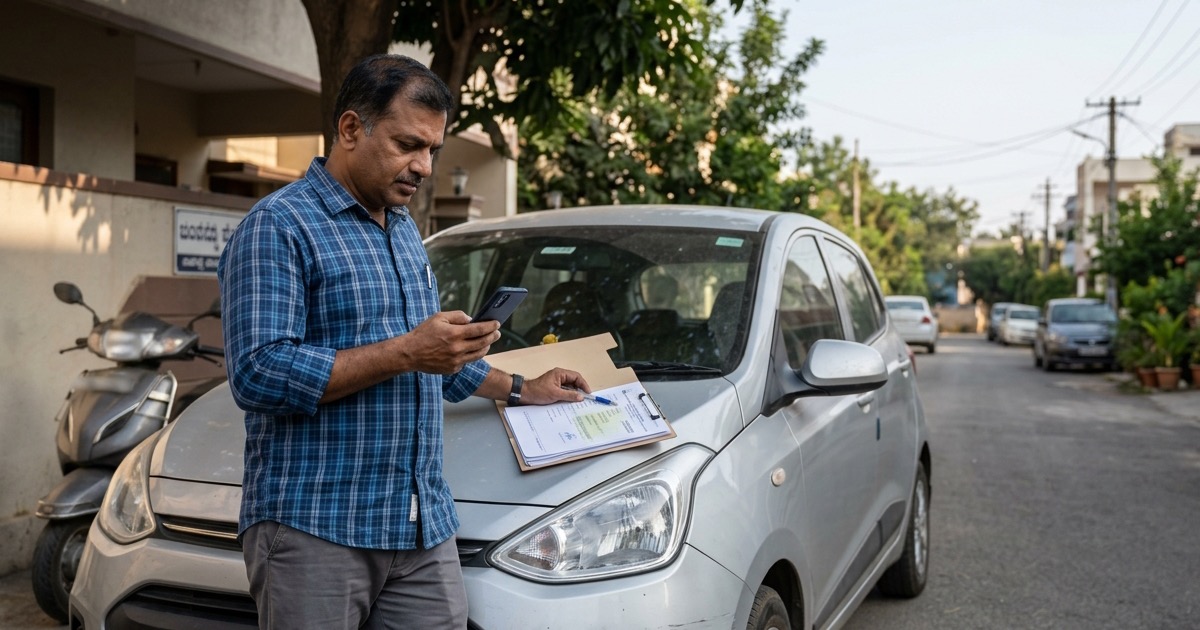
You cannot run a public RC check by chassis number alone through the current Know Your Vehicle Details form: it asks for a Vehicle Registration Number and a captcha. A chassis number still matters enormously in a used-car or bike purchase, because it is the number that ties the physical vehicle to the RC, insurance and sale papers.
Use the official RC check guide early in the deal with the registration number, then use the VIN decoder only to understand the physical identifier. Neither tool turns a chassis number into permission to retrieve another person’s ownership details.
If the factory build date is part of your decision, compare it separately with the car manufacturing-date tool. It is a specification check, not an RC or ownership lookup.
Can You Search RC Details by Chassis Number Alone?
The public Know Your Vehicle Details form is set up for a supplied vehicle number. Its visible fields are Vehicle Registration Number and Captcha Verification. So if a seller has not provided the plate, there is no public chassis-number box to use as a substitute.
That is sensible from a buyer’s perspective too. The chassis number is permanently attached to a vehicle and appears on documents. Publishing an unrestricted “enter a chassis number, receive owner details” route would expose far more than a buyer needs to decide whether to inspect a vehicle. A legitimate buyer needs the recorded owner to participate and show documents, not a data broker’s database extract.
For a normal viewing, use this order:
- Get the registration number from the seller and run the official lookup described in the VAHAN Parivahan portal guide.
- Ask to see the original RC or an issued RC in the owner’s DigiLocker or mParivahan account.
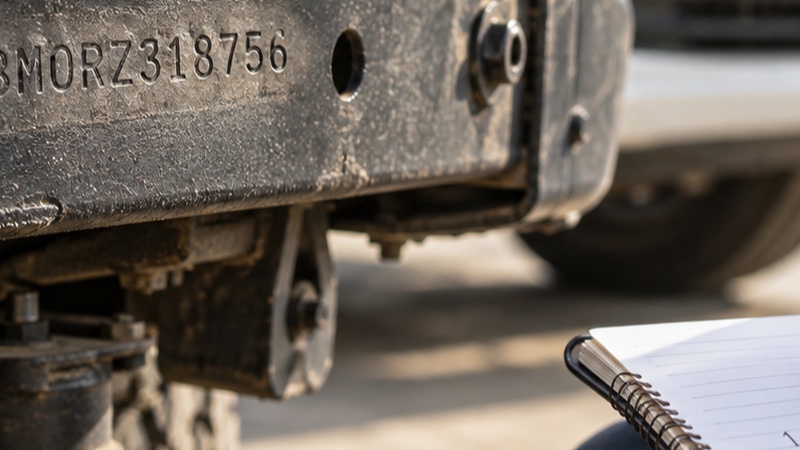
- Inspect the physical chassis stamp and compare it character by character with the full RC field.
- Check the insurance certificate, invoice and any finance paperwork for the same identifier.
An illustrative sequence such as MA1AB2CD3E4F56789 is useful only for practising a character count. It is not a real vehicle record and should never be entered into third-party services to hunt for an owner.
When VAHAN Does Ask for a Chassis Number
VAHAN can ask an owner for the complete chassis and engine number as an authentication detail in a transaction. That is different from a public lookup. Parivahan’s official mobile-number-update instructions, for example, tell the applicant to choose Other Services then Update User Mobile No, and enter Registration No., Chassis No. (Complete), Engine No. (complete) and the previous registered mobile number before generating an OTP.
The distinction is worth remembering:
| Situation | What the official service uses | What it proves |
|---|---|---|
| Buyer’s quick check | Registration number and captcha in Know Your Vehicle Details | Basic record details for that supplied plate. |
| Owner changing the registered mobile number | Registration number, complete chassis number, complete engine number, old registered mobile number and OTP | A protected transaction tied to the record, not a public search. |
| Registration or transfer paperwork | Vehicle documents, and where required, chassis and engine pencil print | The authority can verify the vehicle being presented. |
| mParivahan virtual RC | Owner’s official app access and linked record | An electronic record for the owner, not a buyer’s substitute for transfer papers. |
Do not ask a seller to disclose OTPs or account credentials. Instead, ask them to open their own issued document while you are present. The DigiLocker RC download guide explains the owner route; a buyer should treat it as evidence to compare, not as a document to “borrow.”
Match the Physical Chassis Number to the RC
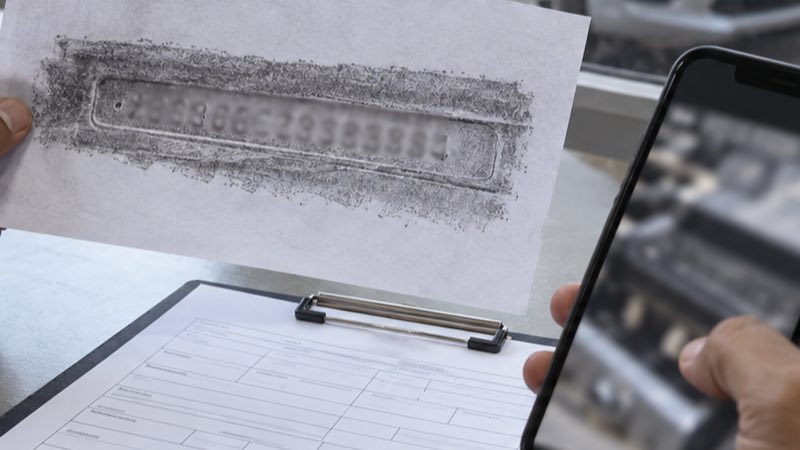
The full chassis number should agree everywhere. Public results may show only a partial identifier, so do not decide that the vehicle matches merely because the last few characters look similar.
| Compare | How to check it | Stop if |
|---|---|---|
| Stamped chassis number | Let the seller point out the original stamp on structural metal. Use light and clean the area gently, without scratching it. | Characters are ground down, uneven, partly hidden by fresh paint or differ from the RC. |
| Original RC or issued digital RC | Read the full chassis field, not just a photo or a masked public suffix. | The seller will show only a cropped image, a photocopy with altered characters, or no document. |
| Engine number | Locate the maker-specific engine stamp and compare it with RC/insurance details. | It is missing, altered or inconsistent with the paperwork. |
| Insurance and invoice | Check the same identifier on current policy and historical sale documents. | The documents point to different vehicles or have unexplained overwriting. |
Cars may have a windshield VIN window, a door-frame label, an engine-bay stamp or a floor-pan stamp. Bikes commonly carry the frame number near the steering head or on the frame. Location varies by maker and model. If the stamp is hard to access, use the owner’s manual or an authorised service centre, not a random scraping or repainting attempt. The bike RC check guide covers the same comparison for two-wheelers.
Take a clear photo of the surrounding metal with the seller’s permission. It helps retain evidence of condition, but it does not replace an RTO inspection when something looks wrong.
What to Do When the Plate or RC Is Missing
A missing plate or misplaced RC changes the deal. It does not make a chassis-only purchase safe.
If the seller says the plate is lost, ask them to provide the registration number from the original RC, insurance policy, tax receipt or a previous official record, then run the public plate lookup. If they say the RC is lost, the recorded owner should handle the duplicate or related request with the registering authority. Do not take a token because someone promises to “find it from the chassis later.”
For an unregistered new vehicle, there may not yet be a registration number to search. That is a different situation: compare the assigned chassis and engine numbers against the manufacturer paperwork, including Form 22 where applicable, and do not confuse a pre-registration inspection with an RC lookup. Parivahan’s permanent-registration guidance lists Form 22 and, in some cases, chassis and engine pencil print among the documents for registration.
For an estate, accident recovery or a vehicle with disputed title, involve the registering RTO and, where appropriate, the police or insurer. A private buyer cannot resolve a title question with a decoder or a paid database.
For example, if a seller has a car in front of you but says the number plates and RC are both unavailable, ask for the registration number from an insurer document and the recorded owner’s identity before arranging another viewing. A seller who cannot produce either a traceable record or the recorded owner is asking you to take a title risk that a chassis number cannot solve.
Red Flags During Chassis Verification
Treat a mismatch as a stop sign, not a bargaining point.
- One-character mismatch:
8andB, or5andS, can look similar in poor light. Cleanly inspect the stamp, but do not accept “it is probably the same.” - Fresh paint, grinding or welding near the identifier: these can have innocent repair explanations, but they need documented clarification from the owner and authority before purchase.
- Seller will not produce the recorded owner: a sale should be traceable to the person on the RC. Parivahan’s transfer guidance identifies Forms 29 and 30 for a normal sale.
- Active finance or an unresolved service flag: verify the underlying lender or authority record before payment. A chassis match does not remove hypothecation.
- A website promises unmasked owner details for a fee: it adds no proof of title. Keep your money and use the official route.
The useful rule is simple: use the registration number to find the public record, then use the chassis number to prove that record belongs to the metal vehicle you are about to buy. The RC status guide puts that comparison into the full used-vehicle sequence. If the two checks do not meet cleanly, walk away until the recorded owner resolves the issue.
Frequently asked questions
Can I get a registration number from a chassis number online in India?
The public Know Your Vehicle Details form is a registration-number lookup. It does not present a chassis-number field for an unrestricted reverse search.
How do I check whether a chassis number matches an RC?
Inspect the original stamped identifier on the vehicle and compare every character with the full chassis field on the RC, insurance record and sale documents. Do not rely only on a masked suffix shown in a public result.
Why does VAHAN ask for a chassis number in some services?
Owner-facing VAHAN transactions can use complete chassis and engine numbers with the registration number and registered mobile verification. That authentication step is different from a public vehicle-details lookup.
What should I do if the chassis number differs from the RC?
Do not buy or take delivery of the vehicle. Ask the recorded owner to obtain clarification from the registering authority and insurer, and involve police if there are signs of tampering or theft.
Sources & official references
- Parivahan: Know Your Vehicle Detailsanalytics.parivahan.gov.in
Official public form showing vehicle registration number and captcha fields.
- Parivahan FAQ: Update User Mobile Numberparivahan.gov.in
Official example of an owner-facing VAHAN service requiring registration number, complete chassis number, complete engine number and registered mobile number.
- Parivahan: Permanent Registrationparivahan.gov.in
Official registration guidance listing chassis and engine pencil print among documents that may be required.
- MoRTH: A Step to Virtualizationparivahan.gov.in
Official description of mParivahan and virtual RC services.
- Parivahan: Transfer of Ownershipmparivahan.parivahan.gov.in
Official transfer guidance and documents for a normal sale.