
Tata Chassis Number Decoder: Free Online Lookup
Enter a 17-character Tata Motors VIN to read the maker prefix, model family, model-year letter and month letter, then compare it with the vehicle and its papers.
Tata Motors is the one Indian maker whose chassis numbers are widely believed to encode the production month, and it is also the maker whose numbers buyers argue about most at delivery. Enter a Tata VIN above and the decoder reads the MAT prefix, a model family from the descriptor digits, the model-year letter in position 10 and the month letter in position 12. Use the result to check a dealer's story, then confirm it against Form 22 and the RC.
MAT: the Tata Motors prefix
| Prefix | What the decoder shows | Notes |
|---|---|---|
MAT | Tata, India, car | Passenger cars and SUVs from Pune, Sanand and Ranjangaon, including every EV |
MB1 | Tata, India, commercial | Trucks and buses carry a different allocation and will not match the families below |
MCA | Fiat or Jeep, India | Jeep Compass and Meridian are built at the Fiat joint-venture plant in Ranjangaon, not under MAT |
Every Nexon, Punch, Altroz, Tiago, Tigor, Harrier, Safari and Curvv starts with MAT. If a car sold as a Tata starts with anything else, stop and ask.
Positions 4 to 9: Tata model families by number
Tata's descriptor section usually starts with digits, but Tata does not publish what they mean. The table lists the prefixes the decoder matches today. We built it from chassis numbers we have seen, not from a Tata document, and real numbers fall outside it. A 2021 Nexon VIN quoted in a MotorBeam report starts MAT627. Treat a match as a hint and confirm the model on the RC:
| Positions 4 onward | Model family the decoder shows | Segment | Fuel options in that family |
|---|---|---|---|
621 | Tiago or Tigor | Hatchback or compact sedan | Petrol, CNG, electric |
622 | Nexon | Compact SUV | Petrol, diesel, electric |
623 | Punch | Micro SUV | Petrol, CNG, electric |
624 | Altroz | Premium hatchback | Petrol, diesel, CNG |
630 | Hexa or Aria | Large SUV, discontinued | Diesel |
631178 | Harrier or Safari | Mid-size and three-row SUV | Diesel |
611003 | Indica Vista or Indigo | Older hatchback and sedan | Diesel |
A 622 result on a Nexon petrol and a Nexon.ev looks the same at this level, so the family cannot tell you the powertrain. Harrier.ev and Curvv are not yet mapped and will return the maker and year without a family. Those are gaps in our table rather than warnings about the car.
Tata year letter (position 10) and month letter (position 12)
Position 10 follows the ISO 3779 letter: R for 2024, S for 2025, T for 2026, with the full chart lower on the page.
Position 12 is the month letter the decoder shows as "Manufacturing month". Owners and dealers report this convention for Tata more often than for other makers:
| Letter | Month | Letter | Month |
|---|---|---|---|
A | January | G | July |
B | February | H | August |
C | March | J | September |
D | April | K | October |
E | May | L | November |
F | June | M | December |
Tata has not published this table, so treat the month as a clue to check rather than proof. The recorded Date of Manufacture on Form 22, and after registration on the RC, is what an RTO and an insurer use. When a dealer says the month letter is wrong, ask to see Form 22. The Tata manufacturing-date check covers that conversation step by step.
Position 9 is not a check digit on an Indian VIN. A check-digit warning on a MAT number can be ignored. A 16-character number cannot.
Worked example: a Nexon chassis number
Illustrative only: MAT622147SPL12345 is made up and does not identify a real vehicle.
| Characters | Position | What the decoder shows |
|---|---|---|
MAT | 1 to 3 | Tata, India |
622147 | 4 to 9 | Nexon family, petrol, diesel or electric |
S | 10 | 2025 model year |
P | 11 | Maker-defined, not decoded |
L | 12 | November, shown as manufacturing month |
12345 | 13 to 17 | Production sequence |
If this car is offered as a "fresh 2026 stock" Nexon, the year letter says otherwise. If Form 22 reads 11-2025, the letter and the document agree and the car is simply older stock, which is a pricing point rather than a defect.
Where Tata puts the chassis number
Location differs by model. The Punch.ev owner manual identifies a VIN plate near the front passenger seat and the chassis-number punching near the driver seat. The Tata EV manual page hosts the manuals for the Sierra.ev, Harrier.ev, Nexon.ev, Curvv.ev, Punch.ev, Tiago.ev and Tigor.ev, each with its own diagram.
| Where to compare | What to check |
|---|---|
| Punched chassis number | The full number in metal. Use the model's manual to find it; do not scrape or probe the stamp |
| VIN plate or label | The same 17 characters where the manual shows one |
| Form 22 and Form 20 before registration | Chassis number and manufacturer details |
| RC after registration | Chassis number and the Date of Manufacture field |
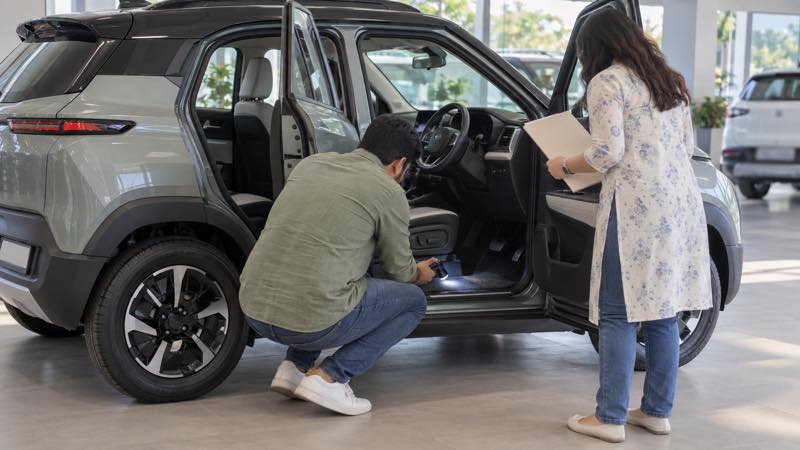
Older Tatas, including the Indica and Indigo families, usually carry the stamp in the engine bay. If a mark is hidden or looks re-struck, ask an authorised Tata workshop to show you the correct location before you continue.
What a Tata VIN leaves out
- The variant and powertrain. Smart, Pure, Creative, Fearless and Accomplished, and petrol versus diesel versus EV, are on the invoice and Form 22.
- The battery. Nexon.ev medium-range and long-range packs are not in the VIN.
- Ownership and claims. The decoder reads the number's structure. The RC check guide covers VAHAN and mParivahan.
- Recall completion. Tata runs campaigns by chassis number through dealers.
Before you take delivery of a Tata
- Copy the chassis number from the punched stamp or VIN plate, not from the dealer's allotment message.
- Decode it above. Check that the family matches the model, and the year letter matches what you were sold.
- Compare the month letter with Form 22. A gap of more than three or four months is worth a conversation. Our guide to an old manufacturing date on a new car sets out what to ask for.
- Run the pre-delivery inspection checklist before you sign the delivery note.
For other Indian makers, see the Maruti Suzuki, Hyundai and Mahindra pages. Each has its own prefix and family table.
Anatomy of a VIN, character by character
Every position has a job, set by the ISO 3779 standard and U.S. federal rule 49 CFR Part 565. Tap a section to see what it encodes.
World Manufacturer Identifier (WMI)
The first character is the region or country of manufacture. The second is the manufacturer, and the third is usually the vehicle type or division. Low-volume makers (under 1,000 vehicles a year) use a 9 in position 3 and carry an extra code in positions 12–14.
Vehicle Descriptor Section (VDS)
Five characters the manufacturer uses to describe the vehicle: model line, series, body type, engine and restraint system. Each maker defines its own scheme, which is why decoding needs a manufacturer database like NHTSA's vPIC.
Check digit
Each character is converted to a number, multiplied by a positional weight, summed and divided by 11. The remainder, 0–9 or X for 10, must equal position 9. A mismatch means a typo or a VIN that deserves a closer look.
Model year
One letter or digit maps to the model year and repeats every 30 years. For North American cars and light trucks, a digit in position 7 points to 1980–2009 and a letter points to 2010–2039. The full chart is below.
Assembly plant
The manufacturer's code for the factory that built the vehicle. It's useful for recall campaigns, which are often limited to one plant and date range.
Production sequence
The serial number of this vehicle on the production line. Combined with the first eleven characters it makes the VIN unique. For low-volume makers, positions 12–14 complete the manufacturer code.
VIN model year chart
The 10th character of every VIN. The letters I, O, Q, U and Z and the digit 0 are never used here.
- A19802010
- B19812011
- C19822012
- D19832013
- E19842014
- F19852015
- G19862016
- H19872017
- J19882018
- K19892019
- L19902020
- M19912021
- N19922022
- P19932023
- R19942024
- S19952025
- T19962026
- V19972027
- W19982028
- X19992029
- Y20002030
- 120012031
- 220022032
- 320032033
- 420042034
- 520052035
- 620062036
- 720072037
- 820082038
- 920092039
Which cycle? On North American cars and light trucks, check position 7. If it's a number the vehicle is from 1980–2009, and if it's a letter it's from 2010–2039. The highlighted code is the current calendar year.
Questions, answered
Free Tata Motors chassis number decoder. Read the MAT prefix, model family, year letter and a month clue from a Tata VIN, then confirm it on Form 22.
Do I need to know my Tata model before using this checker?
No. Enter the complete 17-character VIN copied from the vehicle. If vPIC returns model information, use it as a cross-check against the Tata you are inspecting; an empty model field does not prove the VIN is invalid.
What if the Tata chassis number check shows a format or checksum warning?
Copy the number again from the physical vehicle in good light and compare each character with the papers. Do not change a letter to make a result fit. A format or checksum result is a prompt to recheck the transcription, not proof that a chassis stamp has been altered.
Can I use a VIN from a dealer photo or an online advert?
Use it only as a preliminary lead. Before paying a deposit or accepting delivery, inspect the actual vehicle and match all 17 characters with the number in the dealer material and official documents.
Can a Tata chassis number checker tell the exact factory or variant?
Not reliably from the public VIN sources used here. The result may return available make, model or body information, but it is not a factory certificate and does not confirm a specific trim, option pack, engine or transmission.
Should I ask an authorised Tata workshop for help finding the stamp?
Yes, if the model-specific manual does not make the location clear or access is awkward. Ask the workshop to identify the correct point for that model and model year; do not scrape paint, remove trim or alter the area yourself.
Can this tool check whether a used Tata has accident or insurance history?
No. This tool reads VIN structure and available vPIC vehicle attributes. It does not search accident, insurance, service, finance, police, ownership, odometer or registration records.