
Free VIN Check Online: Decode Specs & Recalls
Decode any 17-character VIN for free to verify factory build details, model year, origin, and official NHTSA safety recalls without signing up.
Enter the full 17-character VIN from the vehicle, not a seller's shortened suffix. This free VIN check reads the identifier's factory structure and, for US-market records, returns fields available through NHTSA's vPIC database. It is a useful first comparison before a viewing or delivery, not a vehicle-history report.
Start by matching what the tool returns against the metal vehicle and its papers. If a character differs, stop and resolve it before paying a deposit. One character can matter.
Find the full number before you run a VIN check
For a passenger vehicle, look at the lower driver-side corner of the windscreen from outside. NHTSA also identifies the driver-door-jamb label as a common location, and says the VIN may appear on the registration and insurance documents. See its VIN location and recall guide for the US layout. Stamp location on an Indian vehicle depends on maker and model, so use the owner's manual or an authorised workshop if it is not obvious.
In India, compare the physical chassis marking with the RC, insurance policy and sales papers. The official Form 23 registration certificate includes a chassis-number field, while Parivahan's permanent-registration guidance lists a chassis and engine pencil print among documents that may be required in some states. A public RC result can mask the identifier, so it is not enough for a character-by-character match.
| Place to check | What to copy | Practical caution |
|---|---|---|
| Lower driver-side windscreen | The complete 17-character VIN | Reflections and dirt can make 8, B, 5 and S look alike. View it in good light. |
| Driver-door-jamb label | The complete VIN and any build label details | A label supports the check, but do not use it to explain away a different structural stamp. |
| Chassis or body stamp | The number stamped into the vehicle | Do not scratch, grind, repaint or clean aggressively. Ask the seller or service centre to point it out. |
| RC, insurance and invoice | The full chassis/VIN field | Check each character, not only the last six digits or a photo sent over chat. |
Before entering it, remove spaces and hyphens only if the tool does so automatically. Do not substitute a lookalike character because it seems likely. If the car is in front of you, photograph the surrounding area of the stamp with the owner's permission; a tight crop alone makes later comparison harder.
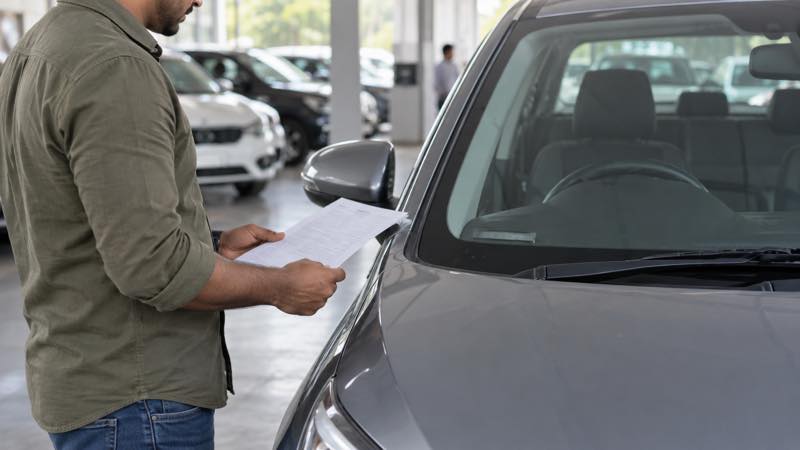
What this free VIN checker reads
A standard 17-character VIN is a structured identifier. The first three characters are the World Manufacturer Identifier, or WMI. The following characters describe the vehicle in a maker-defined way, then the last six form the production sequence. The tenth and eleventh characters are commonly used for model-year and plant coding, but the maker owns the exact interpretation of many positions.
Our decoder shows the structural parts it can establish and uses NHTSA's vPIC API for available US-market fields. NHTSA says vPIC is populated from information manufacturers submit through their 565 filings. That is why a result can include details such as make, model, body class, engine or drive type for some vehicles, while another VIN may return fewer populated fields. An empty field is not a licence to guess a trim or engine.
The ninth-character checksum test applies to North American VIN rules. A pass supports that the characters were entered consistently; it does not prove that the car, seller or paperwork is genuine. A fail can be a typo, a non-North-American format or a number that needs more investigation.
For an Indian 17-character chassis number, use the result to identify the encoded structure and compare it with the car. If manufacturing timing affects a new-car decision, use the separate manufacturing-date check, then read the pre-delivery inspection checklist before accepting delivery.
Worked example: how to read the result
Illustrative only: ABC12D3E4F5G67890 is made up. It is not a real VIN and will not identify a vehicle. It is useful for seeing what the checker separates:
| VIN position | Example characters | What the checker can say |
|---|---|---|
| 1–3 | ABC | WMI. On a real VIN, this points to the assigned manufacturer identifier. |
| 4–8 | 12D3E | Vehicle-description section. Its meaning comes from that maker's own coding. |
| 9 | 4 | Check-digit position for North American VIN validation. |
| 10 | F | Model-year code. Interpret it with the vehicle's market and the applicable code cycle. |
| 11 | 5 | Raw assembly-plant code, not automatically a plant-city name. |
| 12–17 | G67890 | Production sequence. It distinguishes that unit from others in the same series. |
With a real result, look for a sensible agreement: the maker and broad model family should fit the car, and the VIN on the screen should exactly match the windshield, stamp and documents. A decoder cannot settle a mismatch by itself. It only makes the mismatch visible.
What the result can, and cannot, tell you
This tool can decode VIN or chassis-number structure, validate the North American check-digit position where applicable, and show available vPIC vehicle attributes. It can also surface NHTSA recall information for applicable US-market VINs. Check the result again at NHTSA's official recall lookup before you buy or book service.
It does not query registration, ownership, accident, insurance, odometer, finance, service or police records. It cannot tell you whether the seller owns the vehicle, whether a used car has been repaired after a crash, or whether a chassis stamp has been altered. For an Indian registration check, start with the supplied registration number and the RC check guide. For a buyer who has only a chassis number, the RC check by chassis number explainer describes the limits of the public route.
Recall results have limits too. NHTSA says a VIN search does not show recalls already repaired, some recent recalls whose affected VINs are still being identified, most recalls over 15 years old, manufacturer service campaigns, or recalls involving international vehicles. Treat a no-recall result as that specific response, not a complete history certificate.
Common VIN-entry mistakes and quick fixes
| Problem | What to do |
|---|---|
| You copied a 6- or 8-character suffix from an advert | Ask for the complete 17-character VIN and compare it on the car before running the check. |
| The tool reports an invalid length | Count the characters again. Registration portals and public listings sometimes show only a masked suffix. |
| The VIN is rejected after you typed from a photo | Re-read the physical marking in daylight. Do not silently swap 0 for O or 1 for I. |
| A decoded trim, engine or plant field is blank | Leave it blank. Confirm the exact specification from the maker's paperwork, owner's manual or an authorised dealer. |
| The VIN decodes but does not match the RC or insurance | Pause the transaction. Ask the recorded owner to resolve the discrepancy with the registering authority and insurer. |
| The recall result surprises you | Use the official NHTSA VIN lookup and contact the manufacturer or an authorised dealer about the remedy. |
After the free VIN check
Save the full VIN and a clear comparison photo for your records. For a used car, see the physical stamp, the original or issued RC, insurance and the seller's identity before money changes hands. For a new car, compare the allocated VIN with the invoice and Form 22 where applicable, then inspect the car in daylight before registration.
If the number and documents agree, the decode gives you a grounded starting point for specification checks and recall follow-up. If they do not agree, no online VIN checker can make the difference safe. Get it resolved through the maker, insurer or registering authority first.
Buying in the US? Our guides to the free NICB VIN check, where to find the VIN number and Florida VIN verification cover the official US checks.
Where to find the VIN on your car
Standing next to the car? Tap a spot. Check at least two of them. They should match exactly.
Look through the windshield at the lower corner in front of the steering wheel. A metal tag is riveted to the dash. It's the easiest spot to read from outside the car, and zooming in with your phone camera helps in bright sun.
Open the driver door and look at the B-pillar or the edge of the door. The safety certification sticker lists the VIN, often with a barcode you can scan with this site on Android Chrome.
Pop the hood and check the firewall, the front of the engine block or the radiator support. The location varies by maker. Older cars and many trucks have it stamped here.
On trucks, trailers and motorcycles the VIN is often stamped on the frame rail, near a rear wheel well, on a trailer tongue or on the steering head of a motorcycle.
Anatomy of a VIN, character by character
Every position has a job, set by the ISO 3779 standard and U.S. federal rule 49 CFR Part 565. Tap a section to see what it encodes.
World Manufacturer Identifier (WMI)
The first character is the region or country of manufacture. The second is the manufacturer, and the third is usually the vehicle type or division. Low-volume makers (under 1,000 vehicles a year) use a 9 in position 3 and carry an extra code in positions 12–14.
Vehicle Descriptor Section (VDS)
Five characters the manufacturer uses to describe the vehicle: model line, series, body type, engine and restraint system. Each maker defines its own scheme, which is why decoding needs a manufacturer database like NHTSA's vPIC.
Check digit
Each character is converted to a number, multiplied by a positional weight, summed and divided by 11. The remainder, 0–9 or X for 10, must equal position 9. A mismatch means a typo or a VIN that deserves a closer look.
Model year
One letter or digit maps to the model year and repeats every 30 years. For North American cars and light trucks, a digit in position 7 points to 1980–2009 and a letter points to 2010–2039. The full chart is below.
Assembly plant
The manufacturer's code for the factory that built the vehicle. It's useful for recall campaigns, which are often limited to one plant and date range.
Production sequence
The serial number of this vehicle on the production line. Combined with the first eleven characters it makes the VIN unique. For low-volume makers, positions 12–14 complete the manufacturer code.

Buying used? Run this five-minute VIN check
Most used-car scams leave a trace in the VIN. Do these before any money changes hands.
- Match all three VINsThe dashboard plate, the door-jamb sticker and the title must be identical. Scratched rivets or a relabeled sticker are red flags.
- Decode and compare to the listingYear, trim and engine should match what the seller claims. A "V6" listing that decodes to a 4-cylinder is a deal-breaker.
- Check the check digitAn invalid check digit on a 1981+ vehicle means a typo, a grey import or a tampered VIN.
- Look up open recallsFree on NHTSA.gov. Dealers repair recalls at no cost, but you should know about them first.
- Run theft and history checksNICB's VINCheck is free for theft and total-loss records. A paid history report adds accidents, title brands and mileage.
Questions, answered
Run a free VIN check online to decode factory details, model year and US safety recalls. Compare the VIN on a car with its documents before any purchase.
Does a ‘0 unrepaired recalls’ result mean the vehicle has never had a recall?
No. NHTSA says its VIN lookup does not show recalls that were already repaired, some very recent recalls whose affected VINs are still being identified, manufacturer service campaigns, or most recalls over 15 years old. Treat it as the current unrepaired-recall result, then confirm anything important with the manufacturer.
Are recall repairs free in the United States?
For an applicable safety recall, the manufacturer is required to provide a remedy such as repair, replacement, refund or, in rare cases, repurchase. NHTSA explains the recall remedies. Contact an authorised dealer with the VIN to confirm the vehicle is included and arrange the work.
Why can a correctly typed VIN return blank specification fields?
A VIN can be valid even when a database has no value for every field. vPIC returns manufacturer-submitted data, and the level of detail differs by maker, model year and market. A blank trim, engine or plant field is not evidence of a different specification.
Does the tenth VIN character always give the calendar year of manufacture?
No. It is commonly a model-year code, not a guaranteed build-month or registration-date field. Use the maker’s production label and documents when the exact manufacturing date matters.
Should I reject a vehicle if the VIN check digit fails?
Do not ignore it, but do not treat it as final proof of a problem either. The check digit applies to North American VIN rules; first re-check every character against the physical marking. If the number still fails or differs from the documents, pause the transaction and seek written clarification.
Can I use this VIN check to prove title or ownership?
No. A VIN decoder identifies factory information, not the legal owner or title status. In India, use the registration number with the official Parivahan route and compare the full chassis number on the physical vehicle with the RC and insurance documents.