
Vehicle History Check: Free Records & Verification Guide
Decode the VIN here for factory specs and US recalls, then check history records with the official sources we list below.
Use this vehicle history checker first to match a vehicle's VIN or chassis number with its factory identity, then check the records that a VIN can't reveal. vindecode.pro decodes the number's structure and uses NHTSA vPIC data where available; it does not access registration, ownership, accident, insurance, theft, finance, odometer or service records.
That distinction matters when buying used. A clean decode can show whether the identifier fits the stated maker, model year and available specifications, not what happened after it left the factory. Inspect the number and use the official services below.
Find the VIN or chassis number first
Start with the vehicle, not an advert screenshot or a cropped document. On many cars, the VIN is visible at the lower left of the windscreen and may also appear on a door-jamb label. NHTSA says it is also often shown on the registration card and may appear on the insurance card. For Indian vehicles, the stamped location varies by maker and model: look in the owner's manual or ask an authorised workshop to point out the original stamp.
On motorcycles, check the steering-head tube or frame first. A scooter may carry its frame number under the seat or elsewhere on the frame. Use the model's manual before removing any cover. Compare the complete number on the vehicle, RC, Form 22 and insurance document. 0/O, 1/I and 5/S are easy to mix up. Never scrape, sand or use solvent on a stamped area.
| Place to check | What should agree | If it doesn't |
|---|---|---|
| Windscreen label, door jamb or body/frame stamp | The complete identifier, character for character | Stop relying on photos and inspect the original stamp. |
| RC | Chassis-number entry and vehicle description | Ask the recorded owner to resolve a mismatch with the RTO. |
| Form 22 | Maker and chassis-number fields | Treat it as a factory document to compare, not proof of later history. |
| Insurance policy | VIN/chassis entry and registration number | Ask the insurer or seller to correct a transcription error before transfer. |
NHTSA's VIN-location guidance shows the common windscreen and document locations. India's official Form 23 RC and Form 22 both provide fields worth matching.
What this VIN check can confirm
For a standard 17-character VIN, the check can return available factory data such as manufacturer, model year, body class, engine details or plant information. The scope varies by maker and market. ISO 3779 defines VIN content and structure, not a universal trim code for every character.
For US-market vehicles, our results use NHTSA's vPIC database. A blank field is not a reason to guess. NHTSA's VIN recall service reports unrepaired recalls for certain manufacturers, but not repaired recalls or international-vehicle recalls. Check the NHTSA recall search itself before a US purchase.
Illustrative example, not a real VIN: ABC12D3E4F5G67890 has 17 characters. A checker may split it into maker-position characters, a maker-defined descriptor, a check-digit position where applicable, model-year and plant positions, and a serial sequence. On a real vehicle, the recognised maker and broad vehicle type should fit the car in front of you, and the full number should match the papers. It does not prove condition or the seller's story.
For a quick structural result, run a free VIN check. If the claimed build month matters, compare the result and factory documents with this guide to an old manufacturing date on a new car. Registration year and manufacturing timing are not the same thing.
Build the rest of the history from official Indian records
For an Indian used vehicle, use the registration number on VAHAN or mParivahan alongside the physical documents. MoRTH's mParivahan information note says the app can show vehicle/RC particulars and current fitness, insurance, tax, permit and PUC validity. Fitness and permit fields matter mainly for transport vehicles.
Ask the registered owner to open the VAHAN/mParivahan result with you. Compare the registration number, chassis suffix, registration status, insurance and PUCC validity, and any recorded hypothecation with the RC and the seller's documents. A current insurance-validity field is not an insurance-claim history, and a registration lookup is not an ownership-history report. For the practical sequence, see the VAHAN and Parivahan RC check guide and the site’s RC check guide.
Then check the official e-Challan portal using the vehicle number or challan number. Treat a pending challan as a transaction issue to settle and document before ownership transfer. It is not evidence that the vehicle has no accident damage, no loan, or no other liability.
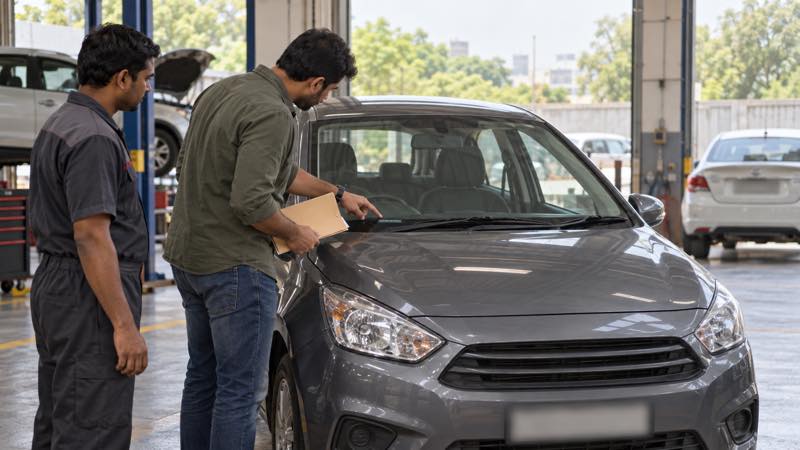
For maintenance and repair history, go with the RC holder to an authorised dealer for the brand. Ask for job cards, invoices and any history the dealer may share. A missing dealer entry is not proof that no service or repair happened elsewhere.
Used-car history checklist: red flags and next moves
| Check | Red flag | What to do next |
|---|---|---|
| VIN/chassis stamp | Uneven characters, fresh paint, grinding marks or a number that differs from the RC | Pause the deal. Have the RTO or an authorised workshop inspect the original mark in person. |
| VAHAN or mParivahan | Registration or hypothecation does not fit the seller's account | Meet the RC holder and get finance release or RTO clarification before payment. |
| Insurance and PUCC | Expired document or a number mismatch | Ask for a corrected, current document; don't assume an expired policy reveals claim history. |
| e-Challan | Unpaid challan | Ask the owner to clear it and retain the payment proof before transfer. |
| Dealer paperwork | Gaps, implausible mileage jumps or a seller unwilling to visit | Get an independent inspection and consider walking away. |
| Body and road test | Uneven panel gaps, warning lamps, flood smell, poor tracking or steering pull | Have an independent mechanic inspect it; database checks can't diagnose condition. |
Take a permission-based photo of the surrounding stamped area and retain copies of the RC, Form 22, insurance, service invoices and challan-clearance proof. The RC check online guide covers the registration side; use it with a road test and an independent inspection.
Common vehicle history check mistakes
- Entering a suffix instead of the full number: Recopy it from the vehicle and documents.
- Treating a decode as a history report: This tool identifies factory information. It cannot discover ownership transfers, accidents, insurance claims or odometer changes.
- Confusing model year with registration year: Check all dated documents.
- Relying on a loose label: A sticker or photo can be replaced. Give more weight to the original structural stamp and consistent paperwork.
- Paying before a mismatch is explained: A seller promise is not a correction. Hold payment until the RTO, insurer, finance company or maker resolves the relevant record.
After the history check: next steps
If the number, decode and documents agree, move to the physical inspection, road test and transfer paperwork. If the number is unclear or differs anywhere, pause. Ask the recorded owner to resolve it through the responsible authority and get the result in writing.
This page is a guide, not a paid vehicle history report. vindecode.pro does not access ownership, accident or insurance records. Use the vehicle-history checker to establish the factory identity, then make the purchase decision only after the official checks and an in-person inspection support it.
For US vehicles, start with the free NICB VIN check for theft and salvage records, then add an NMVTIS title report from an approved provider.

Buying used? Run this five-minute VIN check
Most used-car scams leave a trace in the VIN. Do these before any money changes hands.
- Match all three VINsThe dashboard plate, the door-jamb sticker and the title must be identical. Scratched rivets or a relabeled sticker are red flags.
- Decode and compare to the listingYear, trim and engine should match what the seller claims. A "V6" listing that decodes to a 4-cylinder is a deal-breaker.
- Check the check digitAn invalid check digit on a 1981+ vehicle means a typo, a grey import or a tampered VIN.
- Look up open recallsFree on NHTSA.gov. Dealers repair recalls at no cost, but you should know about them first.
- Run theft and history checksNICB's VINCheck is free for theft and total-loss records. A paid history report adds accidents, title brands and mileage.
Where to find the VIN on your car
Standing next to the car? Tap a spot. Check at least two of them. They should match exactly.
Look through the windshield at the lower corner in front of the steering wheel. A metal tag is riveted to the dash. It's the easiest spot to read from outside the car, and zooming in with your phone camera helps in bright sun.
Open the driver door and look at the B-pillar or the edge of the door. The safety certification sticker lists the VIN, often with a barcode you can scan with this site on Android Chrome.
Pop the hood and check the firewall, the front of the engine block or the radiator support. The location varies by maker. Older cars and many trucks have it stamped here.
On trucks, trailers and motorcycles the VIN is often stamped on the frame rail, near a rear wheel well, on a trailer tongue or on the steering head of a motorcycle.
Questions, answered
Use our free vehicle history checker to decode VIN details, then verify Indian registration, challan and dealer records before a used-car purchase decision.
Is this vehicle history checker a complete history report?
No. vindecode.pro decodes VIN or chassis-number structure and returns available factory data, plus US recall information where available. It does not access ownership transfers, accident reports, insurance claims, registration records, odometer records, finance records or dealer service files.
Can an NHTSA VIN recall result prove a US vehicle is recall-free?
No. NHTSA's VIN search is designed to show unrepaired recalls for certain manufacturers. It does not show recalls already repaired, some newly announced recalls, many recalls older than 15 years, or international-vehicle recalls. Check the VIN directly at NHTSA before purchase.
Does current insurance validity show a vehicle's insurance-claim history?
No. An insurance-validity result confirms the current policy status recorded by the service; it is not a list of claims or accident repairs. Ask the seller for policy and repair documents, and inspect the vehicle independently.
Can e-Challan clear a used vehicle for purchase?
No. The official e-Challan service can help identify pending challans, but it cannot confirm ownership, accident history, insurance claims, finance clearance or mechanical condition. Keep any challan payment proof with the transfer papers.
Why does a VIN result have blank specification fields?
A blank field means the decoder has no supported value to return for that VIN or market. It does not prove a particular trim, engine or option. Compare the VIN with the vehicle, Form 22 and the maker's documents instead of filling gaps from an advert.
What should I take to an authorised dealer for a used-car history check?
Take the vehicle, RC, VIN or chassis number, and the registered owner where possible. Ask for service invoices and job cards that the dealer is allowed to share. Dealer records can be useful evidence, but a gap does not prove the vehicle was never repaired outside that network.