
Chassis Number Check & VIN Decoder
Decode your 17-digit chassis number or VIN for free to check the manufacturer, model year, assembly plant code, and production details.
Run a chassis number check with the full identifier from the vehicle, then compare the result with the RC and Form 22 before you pay or accept delivery. This free chassis number decoder reads the structure of a 17-character VIN. It cannot confirm ownership, registration, accident history, insurance, finance, odometer or police records.
For US-market VINs, results use available data from NHTSA's vPIC database. vPIC says its dataset is populated from manufacturer Part 565 submissions, so a result may contain make, model, body class or engine details where the maker supplied them. A blank field isn't a reason to guess a trim or specification.
Find the number on the vehicle and papers
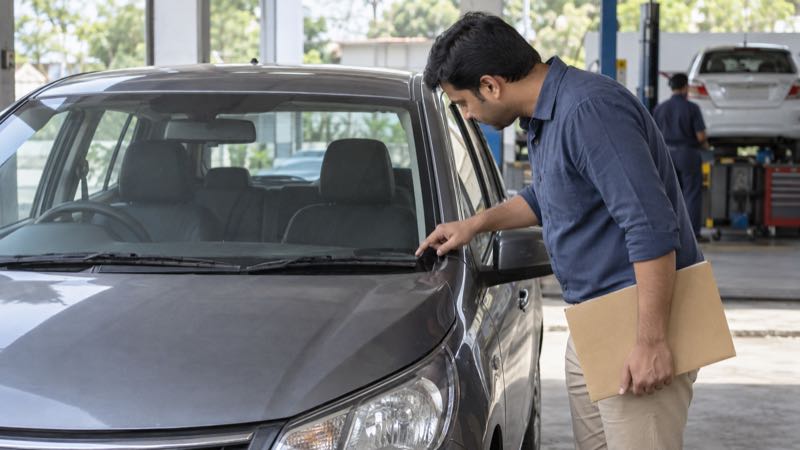
Start with the physical marking, not an advert photo or a six-character suffix. On many cars, a VIN can be seen through the lower driver-side windscreen; a door-jamb label and a body or chassis stamp are other places to compare. NHTSA's VIN location guidance illustrates the windscreen and door-jamb locations used on many vehicles. Indian stamp locations vary by make and model, so check the owner's manual or ask an authorised service centre to show you the original mark.
For a motorcycle, inspect the steering-head tube or frame area first. A scooter's number may be under the seat or on another frame section, rather than at the steering head. Treat those as starting points, not a universal map: Hero's Xpulse 200T 4V owner manual, for example, identifies a VIN on the right steering-head tube. The bike RC check online guide has a practical two-wheeler inspection sequence.
| Where to look | What to compare | Sensible check |
|---|---|---|
| Lower windscreen, door jamb or original body/frame stamp | Every character on the metal and label | Use daylight; don't rely on a blurry listing photo. |
| Motorcycle steering head or scooter frame area | The original frame stamp | Use the specific owner's manual before removing a normal access panel. |
| RC | The chassis-number entry | The official Form 23 RC includes a chassis-number field. |
| Form 22 and sale documents | The chassis number and maker details | Form 22 is the maker's certificate of compliance; compare its chassis field with the vehicle and RC. |
Copy it character by character. 0 and O, 1 and I, and 5 and S are easy to confuse on a dirty stamp or reflected glass. Don't clean the area with abrasives or scrape paint. If you cannot read it, pause and get the seller or an authorised workshop to point out the correct location.
What a 17-character chassis number check reads
The 17-character VIN system has a defined structure. ISO 3779 covers VIN content and structure; NHTSA's VIN rule history explains the 17-character format adopted for vehicles sold in the United States from the 1981 model year. Much of the detail remains maker-defined.
| VIN area | Typical use in a standard VIN | What this checker reports carefully |
|---|---|---|
| 1–3 | World Manufacturer Identifier (WMI) | Assigned maker/region identifier where recognised. |
| 4–8 | Vehicle Descriptor Section | Maker-defined vehicle attributes; not a universal trim code. |
| 9 | Check-digit position | North American checksum validation where applicable. |
| 10–11 | Model-year and plant positions | The model-year code and the raw plant character, not a guessed factory city. |
| 12–17 | Vehicle Identifier Section | Sequence characters; selected Indian patterns may also expose manufacturing timing. |
This isn't a decoder for every stamped vehicle number. Earlier VIN systems used different configurations before the 17-character US standard, and some vehicles have maker-specific chassis or frame identifiers. If the car, commercial vehicle, bike or scooter has a shorter or non-standard stamp, don't add zeros, invent missing characters or force it through this checker. Record it exactly, compare it with the RC and Form 22, then use the maker's manual or the registering authority for the next step.
Worked example: reading a result
Illustrative only: ABC12D3E4F5G67890 is made up. It isn't a real VIN and won't identify a vehicle. It shows how a 17-character chassis number decoder separates the number:
| Positions | Example | How to use the result |
|---|---|---|
| 1–3 | ABC | On a real VIN, check the WMI against the maker shown on the car and documents. |
| 4–8 | 12D3E | Treat this as maker-specific descriptor data, not proof of the exact variant. |
| 9 | 4 | A checksum pass only checks the transcription calculation for applicable North American VINs. |
| 10–11 | F5 | Read the model-year code and plant character in context; registration year can differ from build year. |
| 12–17 | G67890 | Compare all six sequence characters with the physical stamp and papers. |
On a real used car, the recognised maker and broad vehicle family should fit the vehicle in front of you, and every character should agree across the stamp, RC, insurance and Form 22. For brand-specific decoding, use the dedicated Tata chassis number decoder, Mahindra chassis number decoder, Maruti Suzuki chassis number decoder or Hyundai chassis number decoder. If build timing affects a new-car decision, use the separate manufacturing-date checker and a pre-delivery inspection checklist.
What the result cannot tell you
This tool decodes VIN/chassis structure and uses vPIC for available US-market vehicle data. It does not look up registration, ownership, accident, insurance, theft, service, finance, odometer or police records. A passed checksum doesn't prove that the vehicle, seller or paperwork is genuine. A decoded model name doesn't turn a mismatch into a safe purchase.
For an Indian RC or ownership question, begin with the registration number on the official route described in the RC check guide. If you have only a chassis number, the RC check by chassis number guide explains why a structural decode and an official registration lookup are different things. Keep the full number off public listings where you don't need to share it.
Mismatch, tampering and entry mistakes
The common problems are ordinary transcription errors, a masked document, and a number that does not belong to the vehicle. Fix the first two. Stop on the third.
| What you see | What to do next |
|---|---|
| Tool says the length is invalid | Count the physical mark again. A public record or advert may show only a suffix. |
| One character differs between the RC and vehicle | Don't pay a token to “sort it out later.” Ask the recorded owner to resolve it with the RTO and insurer. |
| Fresh paint, grinding, weld marks, filler, uneven characters or disturbed metal around the stamp | Treat it as a serious warning, not proof by itself. Stop the transaction and request in-person RTO verification; if theft or deliberate tampering is suspected, contact the local police. |
| A label agrees but the structural stamp differs | The original structural stamp needs an explanation. A loose label or photograph doesn't settle it. |
| A non-17-character bike or commercial-vehicle number | Do not use a car VIN chart. Match the complete actual identifier to Form 22, RC and the maker's documentation. |
What to do after the chassis number check
Keep a clear, permission-based photo of the surrounding stamped area. For a used vehicle, meet the person recorded on the RC, inspect the original stamp, match the RC and insurance, and make the transfer paperwork traceable. For a new vehicle, match the allocated chassis number to the invoice and Form 22 before registration and delivery.
If the number, documents and decode agree, move on to the vehicle's condition and an independent inspection. If any character or the metal around the mark raises doubt, leave payment on hold until the maker, RTO or police can verify the vehicle in person.
Where to find the VIN on your car
Standing next to the car? Tap a spot. Check at least two of them. They should match exactly.
Look through the windshield at the lower corner in front of the steering wheel. A metal tag is riveted to the dash. It's the easiest spot to read from outside the car, and zooming in with your phone camera helps in bright sun.
Open the driver door and look at the B-pillar or the edge of the door. The safety certification sticker lists the VIN, often with a barcode you can scan with this site on Android Chrome.
Pop the hood and check the firewall, the front of the engine block or the radiator support. The location varies by maker. Older cars and many trucks have it stamped here.
On trucks, trailers and motorcycles the VIN is often stamped on the frame rail, near a rear wheel well, on a trailer tongue or on the steering head of a motorcycle.
Anatomy of a VIN, character by character
Every position has a job, set by the ISO 3779 standard and U.S. federal rule 49 CFR Part 565. Tap a section to see what it encodes.
World Manufacturer Identifier (WMI)
The first character is the region or country of manufacture. The second is the manufacturer, and the third is usually the vehicle type or division. Low-volume makers (under 1,000 vehicles a year) use a 9 in position 3 and carry an extra code in positions 12–14.
Vehicle Descriptor Section (VDS)
Five characters the manufacturer uses to describe the vehicle: model line, series, body type, engine and restraint system. Each maker defines its own scheme, which is why decoding needs a manufacturer database like NHTSA's vPIC.
Check digit
Each character is converted to a number, multiplied by a positional weight, summed and divided by 11. The remainder, 0–9 or X for 10, must equal position 9. A mismatch means a typo or a VIN that deserves a closer look.
Model year
One letter or digit maps to the model year and repeats every 30 years. For North American cars and light trucks, a digit in position 7 points to 1980–2009 and a letter points to 2010–2039. The full chart is below.
Assembly plant
The manufacturer's code for the factory that built the vehicle. It's useful for recall campaigns, which are often limited to one plant and date range.
Production sequence
The serial number of this vehicle on the production line. Combined with the first eleven characters it makes the VIN unique. For low-volume makers, positions 12–14 complete the manufacturer code.
Manufacturer codes (WMI) lookup
The first three characters of a VIN name the manufacturer. Search by code, brand or country.
- 1HGHonda · United States
- 1FAFord cars · United States
- 1FTFord trucks · United States
- 1G1Chevrolet cars · United States
- 1GCChevrolet trucks · United States
- 1C4Chrysler / Jeep / Dodge MPV · United States
- 1C6Ram trucks · United States
- 1N4Nissan cars · United States
- 2HGHonda · Canada
- 2T1Toyota · Canada
- 3VWVolkswagen · Mexico
- 3FAFord · Mexico
- 4T1Toyota cars · United States
- 4S3Subaru · United States
- 5YJTesla · United States
- 5NPHyundai · United States
- 5UXBMW SUVs · United States
- JHMHonda · Japan
- JN1Nissan · Japan
- JTDToyota · Japan
- JM1Mazda · Japan
- JF1Subaru · Japan
- KMHHyundai · South Korea
- KNAKia · South Korea
- WBABMW · Germany
- WDDMercedes-Benz · Germany
- WVWVolkswagen · Germany
- WAUAudi · Germany
- WP0Porsche · Germany
- SAJJaguar · United Kingdom
- SALLand Rover · United Kingdom
- YV1Volvo · Sweden
- ZFFFerrari · Italy
- ZARAlfa Romeo · Italy
- VF1Renault · France
- LRWTesla · China
No match in this list. Decode the full VIN above and NHTSA's database will identify the maker.
Questions, answered
Check any 17-digit chassis number online for free. Decode the manufacturer, model year, manufacturing date and plant code in seconds, with no sign-up needed.
Can I use a chassis number check to find the registered owner?
No. A chassis number decoder reads the identifier's factory structure; it does not access ownership, address, registration, insurance, accident, finance or police databases. For an Indian registration check, use the registration number through the official RC check route and compare the result in person with the vehicle and original documents.
What if my car, bike or scooter number is not 17 characters?
Don't add characters or force a non-standard frame number into a 17-character VIN checker. Record the stamp exactly as it appears, then match it with the RC and Form 22. Ask the manufacturer or registering authority for model-specific confirmation if the number is shorter, longer or partly unclear.
Does a VIN checksum pass prove a vehicle is genuine?
No. A checksum pass only shows that the entered characters satisfy the applicable North American VIN calculation. It cannot prove that the stamp is original, that the RC belongs to the vehicle, or that the seller has clear title.
Is Form 22 the same document as the RC?
No. Form 22 is the manufacturer's certificate of compliance issued for registration, while the RC is the registration certificate issued by the registering authority. During delivery or purchase, compare the chassis number on both with the original vehicle stamp.
Can a chassis number decoder tell me the exact Indian-car variant?
Not reliably in every case. A 17-character chassis number can reveal structural and maker information, but an exact trim, engine or transmission needs support from the manufacturer's own records or documents. Treat a blank or broad result as unknown instead of choosing the nearest variant.
Should I buy a vehicle if the stamped chassis number looks altered?
No. Pause the transaction and do not accept a verbal explanation for grinding, welds, filler, uneven characters or freshly disturbed metal around the stamp. Arrange an in-person RTO verification; if there is reason to suspect theft or intentional tampering, contact the local police.