Trailer VIN Decoder: How to Read Any Trailer or RV VIN
Trailer VIN decoder guide: what the 17 characters mean on utility, cargo and RV travel trailers, small-builder VINs, where to find it and homemade trailers.

Co-Founder & CTO
Saurabh is a technology specialist with deep expertise in AI, full-stack development and scalable platform architecture. He built vindecode.pro from the ground up, including the decoder itself: VIN and chassis number rules, maker-specific conventions and the NHTSA vPIC integration. He leads product development and technical strategy, and writes our guides on how VINs work.
A trailer VIN decoder reads the 17-character VIN that every trailer built for U.S. roads carries and tells you who built it, the model year, the plant and the trailer's type, body, length and axle setup. Enter the full VIN from the trailer's label or title into our free VIN decoder and it pulls those details from NHTSA's vPIC database.
Trailers follow the same federal VIN rules as cars, but they encode different things, and small builders use a special format that confuses many people. This guide covers both, with real decodes we ran in October 2026, plus what to do with a homemade trailer that has no VIN at all.
How a trailer VIN is structured
Federal rules in 49 CFR Part 565 apply to trailers and trailer kits just as they do to cars and trucks. Every VIN has 17 characters, and a check digit must sit in position 9.
| Positions | What they hold on a trailer |
|---|---|
| 1–3 | World manufacturer identifier (WMI): country and manufacturer |
| 4–8 | Make, type of trailer, body type, length and axle configuration |
| 9 | Check digit |
| 10 | Model year |
| 11 | Plant of manufacture |
| 12–17 | Serial number (the last four must be numeric) |
The model year letter in position 10 follows the same chart as cars; see our VIN year chart. One difference: cars and light trucks use the 7th character (letter or number) to tell, for example, a 1992 N from a 2022 N. That rule applies only to passenger cars, SUVs and trucks of 10,000 lb GVWR or less, so it does not cover trailers. In our tests, vPIC also flagged that the decoded model year "may be incorrect" on these trailer VINs, so check the year against the title.
For the general position-by-position explanation, see how to read a VIN.
What positions 4–8 mean on a trailer
Part 565 lists what each vehicle type must encode in the vehicle descriptor section. For a car it is the line, series, body, engine and restraints. For a trailer, including trailer kits and incomplete trailers, it is:
- Make
- Type of trailer (for example, bumper pull or gooseneck)
- Body type (for example, car hauler, enclosed cargo, travel trailer)
- Length
- Axle configuration
There is no engine, so none of the engine-size logic from our car specs by VIN guide applies. The rule lets each manufacturer choose which character carries which attribute, as long as it files the key with NHTSA. That is why the same position means different things for different trailer brands, and why a decoder that uses the manufacturer's own filing is more reliable than a generic chart.
Trailer VIN decode examples
We built VIN patterns from real trailer manufacturer prefixes, set the serial to 100001, recalculated the check digit and decoded each one in vPIC.
Common trailer WMIs in vPIC
| WMI | Manufacturer (vPIC) | Makes listed include |
|---|---|---|
1UJ | Jayco, Inc. | Jayco, Jay Flight, Jay Feather, North Trail |
4YD | Keystone RV | Keystone, Outback, Coleman, Alpine, Arcadia |
4X4, 5NH, 5ZT | Forest River, Inc. | Forest River |
4V0 | DS Corp | Crossroads |
16V | Big Tex Trailer Manufacturing, LLC | Big Tex |
47Z | Pace American of Texas Inc. | Pace American |
RV travel trailers
| Field | 2022 Jayco pattern | 2022 Keystone RV pattern |
|---|---|---|
| VIN pattern | 1UJBJ0BN7N1100001 | 4YDTCKN23NK100001 |
| Body | Camping or travel trailer | Camping or travel trailer |
| Hitch | Bumper pull | Bumper pull |
| Axles | 2 (tandem) | 2 |
| Length | 28 ft to under 30 ft | 32 ft to under 34 ft |
| Plant | Middlebury, Indiana | Goshen, Indiana |
The Keystone pattern decoded with a clean check digit but a note that some positions were not covered by the manufacturer's filing, so vPIC returned no model name. That is common with RV VINs. The trailer's certification label and the title fill the gap.
Utility and cargo trailers
Big Tex's filing is a clear example of how a trailer maker lays out positions 4–8. Changing one character at a time in our test VINs changed one attribute at a time:
| VIN pattern | 4th | 5th | 6th–7th | 8th | vPIC result |
|---|---|---|---|---|---|
16V1C1227N2100001 | 1 | C | 12 | 2 | Bumper pull car hauler, 12 ft, 2 axles |
16V1C2026N2100001 | 1 | C | 20 | 2 | Bumper pull car hauler, 20 ft, 2 axles |
16V1C1218N2100001 | 1 | C | 12 | 1 | Bumper pull car hauler, 12 ft, 1 axle |
16V3E2022N2100001 | 3 | E | 20 | 2 | Gooseneck enclosed (box or van) trailer, 20 ft, 2 axles |
All four came from the Mount Pleasant, Texas plant. In this filing, the 4th character is the hitch type, the 5th the body type, the 6th and 7th the length in feet and the 8th the number of axles. Other manufacturers use different layouts, so do not apply this one to another brand.

Small trailer builders: the 9 in position 3
Many trailers come from small shops, and their VINs follow a different pattern. Part 565 defines a low-volume manufacturer as one that builds fewer than 1,000 vehicles of a given type each year. Instead of a three-character WMI of its own, such a builder gets a six-character manufacturer identifier:
- Position 3 is always
9. A 9 in the third position always means a six-character manufacturer identifier. - Positions 1–3 plus positions 12–14 together identify the manufacturer and vehicle type.
- Only positions 15–17 are the production serial number.
So if the last six characters of a small builder's VIN are TS4087, only 087 is the serial number. The TS4 part, together with the first three characters, is the builder's identity. (Position 14 is still a digit, because Part 565 requires the last four characters of a trailer VIN to be numeric.) If a small builder's VIN decodes with little detail, that usually means the builder filed limited information, not that the VIN is fake. Confirm the check digit is valid and that the VIN on the trailer matches the title.
Where to find the VIN on a trailer
The VIN has to appear clearly and indelibly on a part of the trailer that is not designed to be removed except for repair, or on a plate or label permanently attached to such a part.
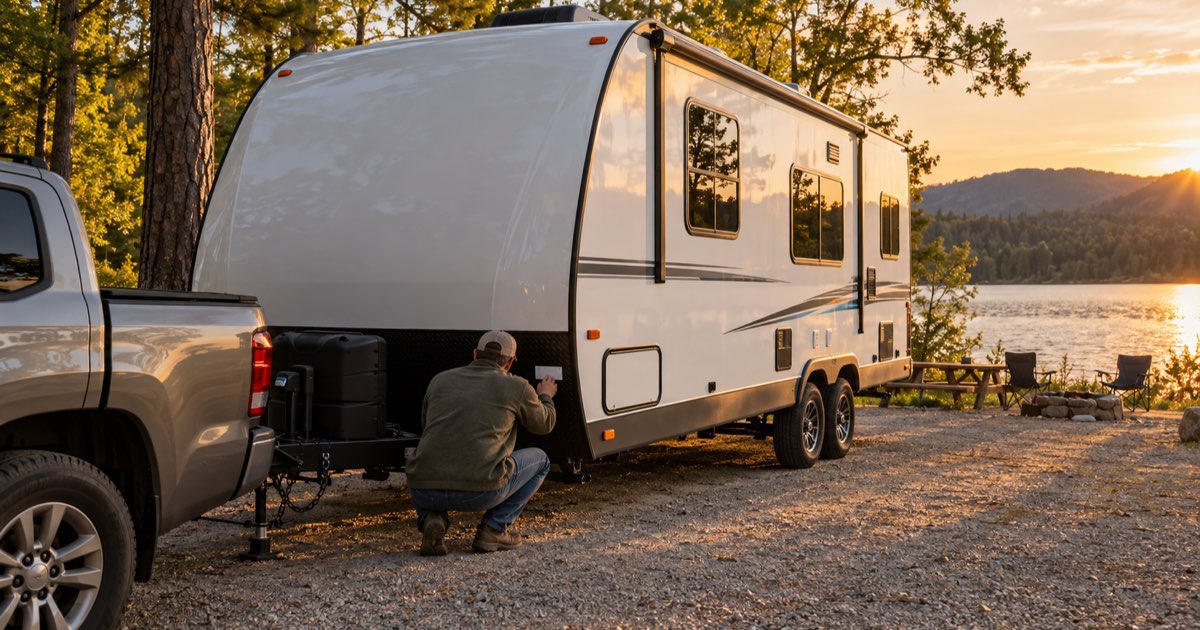
The federal certification label, required by 49 CFR Part 567, must go on the forward half of the left side of a trailer, where it can be read from outside without moving anything. It must show:
- The manufacturer's name (or "Resp Mfr" if a trailer maker takes legal responsibility for a trailer it sells)
- Month and year of manufacture
- Gross vehicle weight rating (GVWR)
- Gross axle weight rating (GAWR) for each axle
- The VIN and the vehicle type ("trailer")
Look at the left side of the front of the body or the left frame rail near the tongue. If the label has faded or fallen off, check the tongue and frame for a stamped number, and compare whatever you find with the title. Our pillar guide on where the VIN number is covers trailers alongside cars, trucks and motorcycles.
Homemade trailers and state-assigned VINs
A trailer you build yourself has no manufacturer VIN, so the state assigns one. Each state runs its own process. New York's form VS-105 is a clear example:
- Under 1,000 lb unloaded: DMV office staff assign a VIN when you register the trailer, using form MV-272. You must put the VIN on the trailer "by stamping, welding or other permanent means." New York does not title trailers under 1,000 lb.
- 1,000 lb or more unloaded: you apply on form MV-272.1. DMV's Division of Field Investigation schedules an examination, sends a temporary transport permit, and affixes the VIN decal after examining the trailer.
- Paperwork: in both cases you need the original sales receipts for the materials and parts, and a weight slip from a certified scale.
Other states use law enforcement inspections or different weight thresholds, so check your state DMV's site before you start. If you are moving a trailer to Florida, note that Florida requires a physical VIN verification for trailers of 2,000 lb or more that are not currently titled there (travel and camp trailers are exempt), as our Florida VIN check guide explains.
A state-assigned VIN will not decode like a factory VIN, because no manufacturer filed it with NHTSA. That is normal. What matters is that it matches the registration and title.
Checking a used trailer before you buy
- Read the VIN from the trailer, not the paperwork, and check that it matches the title.
- Decode it with our free VIN decoder. A failed check digit points to a misread or altered VIN. Compare the decoded length, axles and body type with the trailer in front of you.
- Check the label. Compare the GVWR and axle ratings on the certification label with what you plan to haul.
- Look for recalls. Trailers can be recalled too. Run the VIN through the NHTSA recall lookup.
- Check theft and title records. Trailers are easy to steal and re-sell. Run a free VIN check and a NICB VIN check, and walk away from a trailer with a ground-off or replaced VIN plate and no explanation.
Before you tow, check the trailer's GVWR on its label against your tow vehicle's towing capacity in the owner's manual. The tow vehicle's VIN will not tell you its towing capacity.
Frequently asked questions
How do I decode a trailer VIN?
Enter all 17 characters into a VIN decoder that uses NHTSA's vPIC data. Positions 1–3 identify the manufacturer, 4–8 describe the trailer type, body, length and axles, 9 is the check digit, 10 the model year, 11 the plant, and the rest is the serial number.
Can you decode an RV or travel trailer VIN?
Yes. Travel trailers from makers such as Jayco and Keystone RV decode in vPIC. Our 2022 Jayco example returned 'Camping or Travel Trailer', bumper pull, tandem axle, 28 to under 30 ft, built in Middlebury, Indiana.
Why does my trailer VIN not decode fully?
Small builders often file limited data with NHTSA, and some do not file details for every position. If the third character is 9, the builder is a low-volume manufacturer identified by positions 1–3 and 12–14. A failed check digit usually means a misread character.
Where is the VIN on a trailer?
Federal rules put the certification label, which includes the VIN, on the forward half of the left side of the trailer, readable from outside. Also check the tongue and frame for a stamped number, and compare both with the title.
How do I get a VIN for a homemade trailer?
Apply to your state's motor vehicle agency. In New York, DMV staff assign a VIN for trailers under 1,000 lb at registration, and DMV investigators examine heavier trailers and affix the VIN. Keep receipts for the materials you used.
Sources & official references
- 49 CFR Part 565: Vehicle Identification Number requirementsecfr.gov
17-character format, trailer attributes in positions 4–8, low-volume manufacturer rule
- 49 CFR Part 567: Certificationecfr.gov
Location and contents of the trailer certification label (567.4)
- NHTSA vPIC APIvpic.nhtsa.dot.gov
Source of every decode and WMI in this guide, queried October 2026
- New York DMV: Register a custom or homemade trailer or vehicledmv.ny.gov
Forms VS-105 and MV-272 for homemade trailers
- New York DMV form VS-105: Registration and title for custom (homemade) trailersdmv.ny.gov
VIN assignment by weight, receipts and weigh-slip requirements
- NHTSA recall lookupnhtsa.gov
Check open recalls on a trailer VIN