Motorcycle VIN Decoder: Bike and Dirt Bike VINs, Year Chart
Decode any motorcycle or dirt bike VIN: where it is, what the 17 characters mean, the 10th-digit year chart, WMI codes for Suzuki, Yamaha, Kawasaki and more.

Co-Founder & CEO
Gaurav brings strategic leadership and business development expertise, with a focus on growth and partnerships. He shapes vindecode.pro around the questions buyers and owners actually ask about VINs, RC checks and manufacturing dates, and drives the goal of making it the most trusted free VIN decoder for India and the US.
A motorcycle VIN decoder reads the 17-character vehicle identification number stamped on a bike's frame and turns it into the maker, model, engine size, model year and plant. Every street motorcycle built for the US since model year 1981 has one, usually on the side of the steering head, and you can decode it free against NHTSA's vPIC database.
This guide shows where to find the VIN on a motorcycle, what each character means under federal rules, the manufacturer codes for 10 brands sold in the US, and a full worked decode. For the general rules that apply to cars too, see our guide on how to read a VIN. To decode a bike right now, paste its VIN into our free VIN decoder.
What a motorcycle VIN decoder tells you
Motorcycle VINs follow the same federal standard as car VINs, 49 CFR Part 565. Manufacturers file their VIN-decoding data with NHTSA, which publishes it in the vPIC database. A decoder looks up each block of the VIN against that data.
When we queried NHTSA vPIC in October 2026, a typical motorcycle decode returned:
- Make and manufacturer, for example Harley-Davidson Motor Company
- Model and series, such as Street Glide (FLHX)
- Body class, such as touring or sport
- Engine: displacement in cc, number of cylinders, and often horsepower and cooling type
- Model year and plant city and country
- A check digit result that tells you if the VIN is internally valid
What a VIN does not tell you: mileage, accident history, liens, theft or open recalls. Those come from separate checks, covered at the end of this guide.
Where is the VIN on a motorcycle?
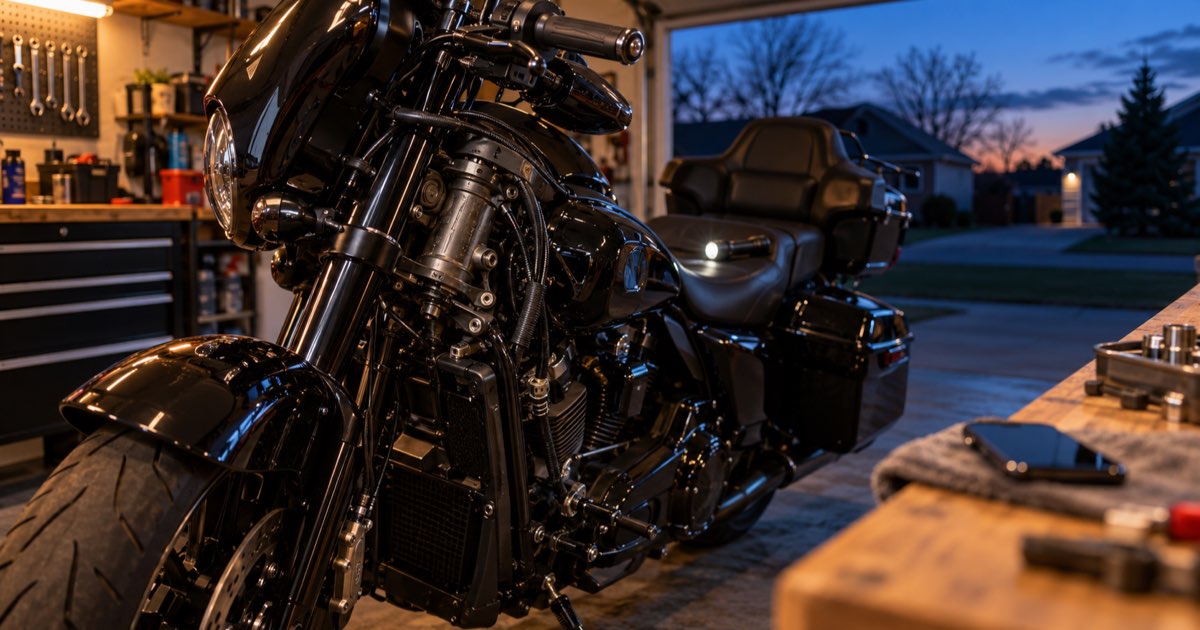
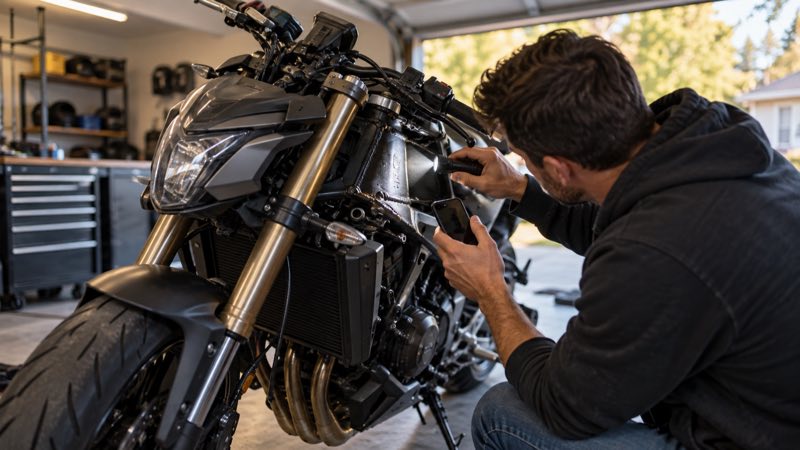
On most motorcycles the VIN is stamped into the frame on the side of the steering head, the short tube behind the front forks that the handlebars pivot on. Turn the bars fully to one side and shine a flashlight on it. Kawasaki's own customer support FAQ states this plainly: "On all motorcycles it is stamped on the side of the steering head."
Federally certified street bikes have a second place to read it: the certification label. Under 49 CFR 567.4, a motorcycle's label must be fixed to a permanent part "as close as is practicable to the intersection of the steering post with the handle bars." The label must show the VIN and the month and year of manufacture.
| Where to look | What you find |
|---|---|
| Side of the steering head (frame neck) | The full 17-character VIN, stamped in metal |
| Certification label near the steering head | VIN, manufacturer, month and year of manufacture, weight ratings |
| Title, registration, insurance card | The VIN as recorded by the state and insurer |
| Engine crankcase | A separate engine number, not the VIN |
The engine number is not the VIN. It identifies the engine only, and engines can be swapped. Titles, registrations, recalls and theft records all key off the frame VIN, so always read that one. Off-road machines put the VIN in other places; our ATV VIN decoder guide covers quads and side-by-sides, and our VIN location guide covers cars, trucks and trailers.
The 17 characters of a motorcycle VIN
Part 565 splits every VIN into four sections. Most rules are the same for cars and motorcycles, but three details differ, and they matter when you decode a bike.
| Positions | Section | What it means on a motorcycle |
|---|---|---|
| 1–3 | World manufacturer identifier (WMI) | Maker and vehicle type. A 9 in position 3 means a low-volume maker. |
| 4–8 | Vehicle descriptor | Must identify make, type of motorcycle, line, engine type and net brake horsepower (model year 2010 on) |
| 9 | Check digit | Math check of the other 16 characters (0–9 or X) |
| 10 | Model year | Letter or number from the federal year table |
| 11 | Plant | Where the manufacturer applied the VIN |
| 12–17 | Production number | Last four must be numeric for motorcycles |
Positions 4–8 for motorcycles. Table I of § 565.15 lists what the vehicle descriptor must make decipherable for each vehicle type. For a motorcycle it is "make, type of motorcycle, line, engine type, and net brake horsepower." Cars must encode body type and restraint systems instead; motorcycles must encode horsepower. The rule adds that encoded horsepower must be within 10 percent of the actual figure, with a special case for bikes of 2 horsepower or less. Bikes from model year 2009 and earlier follow the older Subpart C rules, whose list for motorcycles leaves out make. The manufacturer chooses which characters carry which attribute, so the codes differ by brand. That is why you need a decoder rather than a universal chart.
No alphabetic seventh character. For cars and light trucks, position 7 must be a letter on 2010-and-later vehicles. That rule does not apply to motorcycles. It has a knock-on effect on reading the model year, explained below.
Four numeric characters at the end. Cars must end in five numbers. Motorcycles, like all other vehicle types, must end in four.
Allowed characters. Every VIN uses only capital letters and digits, and never the letters I, O or Q.
Motorcycle WMI codes for major brands
The first three characters tell you who built the bike. These are WMIs that NHTSA vPIC lists with vehicle type "Motorcycle" for each brand, from our DecodeWMI and GetWMIsForManufacturer queries in October 2026. Most brands hold several; the ones below are the main codes for each.
| Brand | Common motorcycle WMIs (vPIC) | Manufacturer named in vPIC |
|---|---|---|
| Harley-Davidson | 1HD, 5HD | Harley-Davidson Motor Company |
| Honda | JH2, 1HF | Honda Motor Co., Ltd. (JH2); American Honda Motor Co., Inc. (1HF) |
| Yamaha | JYA | Yamaha Motor Co., Ltd. |
| Kawasaki | JKA, JKB | Kawasaki Motors, Ltd. |
| Suzuki | JS1 | Suzuki Motor Corporation |
| BMW | WB1, WB3, WB4 | BMW AG Motorcycles |
| Ducati | ZDM | Ducati Motor Holding S.p.A. |
| Triumph | SMT | Triumph Motorcycles Limited |
| KTM | VBK | KTM AG (vPIC lists makes KTM, Husqvarna, Husaberg and GasGas) |
| Indian | 56K | Indian Motorcycle LLC |
The first character is the region code, so J is Japan, W Germany, Z Italy, S the UK, V Austria and 1 or 5 the United States. The WMI identifies the manufacturer, make and vehicle type, not always where the bike was built. Position 11 identifies the plant, which Part 565 defines as the plant where the manufacturer affixes the VIN. Kawasaki is a good example: full VINs starting JKA or JKB can decode to its Lincoln, Nebraska plant for off-road models and to Akashi, Japan for sport bikes. Our brand guides go into each maker's codes: Kawasaki, Yamaha, Honda motorcycle VIN decoder, Suzuki motorcycle VIN decoder and KTM VIN decoder.
A worked motorcycle VIN decode
Here is a full decode of a real VIN pattern. It comes from NHTSA recall report 24V-672, which lists a range of 2024 Harley-Davidson touring bikes beginning 1HD1KB71. We replaced the serial with 100001 and recalculated the check digit, giving 1HD1KB716RB100001. vPIC decoded it as follows in October 2026.
| Position | Character(s) | vPIC result |
|---|---|---|
| 1–3 | 1HD | Harley-Davidson Motor Company, motorcycle |
| 4–8 | 1KB71 | Street Glide, series FLHX, touring body class, 1,923 cc two-cylinder Milwaukee-Eight engine, 105 hp, air cooled |
| 9 | 6 | Check digit, correct |
| 10 | R | 2024 model year |
| 11 | B | York, Pennsylvania |
| 12–17 | 100001 | Production number (our placeholder) |
Note the horsepower figure. It is there because Part 565 requires net brake horsepower to be decipherable from a motorcycle VIN. For the rest of Harley's code system, see our Harley-Davidson VIN decoder.
How the check digit works
The check digit lets anyone catch a mistyped or altered VIN. The method is set out in § 565.15(c):
- Convert each letter to a number: A=1, B=2, C=3, D=4, E=5, F=6, G=7, H=8, J=1, K=2, L=3, M=4, N=5, P=7, R=9, S=2, T=3, U=4, V=5, W=6, X=7, Y=8, Z=9. Digits keep their value.
- Multiply each position by its weight: 8, 7, 6, 5, 4, 3, 2, 10, 0, 9, 8, 7, 6, 5, 4, 3, 2.
- Add the 17 products and divide by 11. The remainder is the check digit. A remainder of 10 becomes X.
For 1HD1KB716RB100001 the products are 8, 56, 24, 5, 8, 6, 14, 10, 0, 81, 16, 7, 0, 0, 0, 0 and 2. They add up to 237, and 237 divided by 11 leaves 6, which matches position 9. If a seller's VIN fails this check, either it was copied wrong or something is off with the paperwork or frame.
Reading the model year on a motorcycle
The 10th character is the model year. The codes run A for 1980 through Y for 2000, then 1 to 9 for 2001–2009, then start again at A for 2010. So 2024 is R, 2025 is S and 2026 is T. Our VIN year chart lists every code.
The catch is that the letters repeat every 30 years. On cars and light trucks, Part 565 settles which cycle applies: a numeric 7th character means 1980–2009 and a letter means 2010–2039. That rule covers passenger cars, MPVs and trucks only, not motorcycles. So an R in position 10 of a bike's VIN could mean 1994 or 2024, and the VIN alone does not say which.
vPIC flags this. Our decode of the Harley example came back with the note that "the Model Year decoded for this VIN may be incorrect," and the vPIC API documentation recommends always sending the model year with a decode request. In practice the model, engine and styling usually make the answer obvious. When in doubt, check the year on the title and the month and year printed on the certification label.
Motorcycle and dirt bike VIN year chart
This chart works for every brand, including Harley-Davidson, Honda, Yamaha, Kawasaki and Suzuki, and for dirt bikes that carry a 17-character VIN. Each code has two possible years. Pick the one that fits the bike.
| 10th character | Years | 10th character | Years |
|---|---|---|---|
| A | 1980 or 2010 | S | 1995 or 2025 |
| B | 1981 or 2011 | T | 1996 or 2026 |
| C | 1982 or 2012 | V | 1997 or 2027 |
| D | 1983 or 2013 | W | 1998 or 2028 |
| E | 1984 or 2014 | X | 1999 or 2029 |
| F | 1985 or 2015 | Y | 2000 or 2030 |
| G | 1986 or 2016 | 1 | 2001 |
| H | 1987 or 2017 | 2 | 2002 |
| J | 1988 or 2018 | 3 | 2003 |
| K | 1989 or 2019 | 4 | 2004 |
| L | 1990 or 2020 | 5 | 2005 |
| M | 1991 or 2021 | 6 | 2006 |
| N | 1992 or 2022 | 7 | 2007 |
| P | 1993 or 2023 | 8 | 2008 |
| R | 1994 or 2024 | 9 | 2009 |
The letters I, O, Q, U and Z and the digit 0 are never used for the year. A number in position 10 is the only case with one answer, because digits 1 to 9 cover 2001–2009 and are not reused until 2031. Remember this is the model year, which can differ from the month and year the bike was built. The certification label shows the build date.
Suzuki and other Japanese brands. A Suzuki VIN starting JS1 with an L in position 10 is a 1990 or a 2020 model, and the engine and bodywork make it obvious which. The same reading applies to JYA (Yamaha), JKA or JKB (Kawasaki) and JH2 (Honda).
Dirt bike VIN decoder: what changes off-road
A dirt bike VIN uses the same 17-character layout as a street bike, and a modern motocross or enduro bike from Honda, Yamaha, Kawasaki, Suzuki or KTM will usually decode. Three things work differently.
Where to find it. On most dirt bikes the VIN is stamped on the steering head, the same place as on a street bike. Mud, number plate backgrounds and fork guards often hide it, so clean the area gently rather than scraping. The engine number is stamped separately on the crankcase.
What the decoder returns. Off-road-only bikes are not built to the Federal Motor Vehicle Safety Standards, so vPIC usually adds a warning that the vehicle is not a certified motor vehicle. That warning is expected and does not mean the VIN is fake. Our ATV VIN decoder guide explains the error code in detail. Off-road-only bikes are also not required to carry the federal certification label that street bikes have near the steering head, so the VIN stamp and the title or MCO are your sources for the year.
State rules on off-road VINs. Some states read road and emissions status from the VIN at registration. California's REG 31 instructions, for example, say a 2003 or newer off-highway vehicle with a "3" or "C" in the 8th position of the VIN is non-complying, the class California registers with a red sticker. California also says an off-highway motorcycle cannot be converted to street use unless it was manufactured as dual-purpose. Our California VIN verification guide covers the paperwork.
Free dirt bike VIN checks. Before you buy a used dirt bike, decode the VIN, confirm the year with the chart above, and run it through NICB VINCheck, which is free and searches theft and salvage records reported by participating insurers. A VIN that is ground off, restamped or does not match the paperwork is a reason to walk away.
Pre-1981, custom and low-volume bikes
Pre-1981 motorcycles. NHTSA says vPIC "is intended for use on Model Years 1981 and forward," and vehicles from before the 1980s VIN standard are not decoded. Older bikes carry frame and engine numbers in formats each maker chose for itself. A modern decoder will reject them or return nothing. For these, rely on the title, the manufacturer's historical records and marque clubs.
Low-volume builders. For model year 2010 on, Part 565 defines a low-volume manufacturer as one building fewer than 1,000 vehicles of a type a year. These makers put a 9 in position 3 and use positions 12–14 as the rest of their identifier, so only positions 15–17 are a serial number. vPIC lists six-character motorcycle identifiers like this, for example 1Z9247 for a small US custom builder. Custom and kit bikes may also carry a state-assigned VIN rather than a factory one.
Replacement frames. Because the VIN lives on the frame, a new frame raises the question of which number the bike now carries. Manufacturers generally will not stamp a fresh VIN. Kawasaki's support FAQ, for example, says it "does not issue duplicate VIN or frame numbers" and sends owners to the state where the vehicle is registered to get a new VIN for a replacement frame. If you are looking at a bike with a state-issued VIN, ask for the paperwork that explains why, and expect a decoder to return little or nothing for it.
VIN checks before you buy a used motorcycle
A decode confirms what the bike should be. These checks tell you what has happened to it.
- Match the VINs. Read the VIN on the steering head and the certification label and compare both with the title character by character. Ground-off, restamped or mismatched numbers are a reason to walk away.
- Decode it. Run the VIN through a decoder, such as the free one on our home page, and confirm the model, engine size and year match the ad.
- Check theft and salvage records. NICB VINCheck is free and shows whether a member insurer has reported the VIN as stolen and not recovered, or as salvage. Our NICB VIN check guide explains what the results mean.
- Check open recalls. Under 49 CFR 573.15, any maker that sold or imported 5,000 or more motorcycles in the US in the current or prior calendar year must offer a free recall search by VIN. You can also use NHTSA's recall lookup, which searches the major car and motorcycle makers. Our guide to recall checks by VIN walks through both.
- Get a history report if the price justifies it. A paid report can add title brands and past registrations that a free check will not show.
For a dirt bike, quad or side-by-side, the same steps apply, but vPIC coverage and decoded fields vary for off-road models, so confirm road-use status with the manufacturer and your state. The ATV guide linked above covers those machines.
Frequently asked questions
Where is the VIN on a motorcycle?
On most motorcycles the VIN is stamped on the side of the steering head, the frame tube behind the forks. Turn the handlebars to one side and use a flashlight. Federally certified street bikes also carry a certification label near the steering head that repeats the VIN and shows the month and year of manufacture.
Is the engine number the same as the VIN on a motorcycle?
No. The VIN identifies the whole motorcycle and is stamped on the frame. The engine has its own number on the crankcase. Titles, registration, recalls and theft checks all use the frame VIN.
How do I find the year of my motorcycle from the VIN?
Read the 10th character and match it to the model year chart. Because motorcycles do not use the position-7 rule that cars use, the same letter repeats every 30 years. R, for example, can mean 1994 or 2024, so check the title or certification label to confirm.
Can I decode a motorcycle VIN for free?
Yes. NHTSA's vPIC database decodes 1981-and-later motorcycle VINs for free, and the free VIN decoder on vindecode.pro reads the same data. It shows make, model, engine size, model year and plant.
Do motorcycles get recalls I can check by VIN?
Yes. Federal rules require any manufacturer that sold or imported 5,000 or more motorcycles in the US in the current or prior calendar year to offer a free recall search by VIN, and NHTSA's own recall lookup searches the major motorcycle makers' records.
Can I decode a dirt bike VIN?
Yes, if it has a 17-character VIN, which modern dirt bikes from the major brands do. NHTSA vPIC usually decodes the make, model and engine, and adds a warning that the bike is not a certified motor vehicle. That warning is normal for off-road-only machines.
What year is my dirt bike from the VIN?
Read the 10th character and look it up in the year chart. Letters repeat every 30 years on motorcycles and dirt bikes, so an L can mean 1990 or 2020. A number from 1 to 9 means 2001 to 2009. Confirm with the title or MCO.
Sources & official references
- 49 CFR Part 565: Vehicle Identification Number requirementsecfr.gov
VIN structure, Table I (what positions 4–8 must encode for motorcycles), check digit, year codes
- 49 CFR 567.4: Certification label requirementsecfr.gov
Motorcycle label location near the steering post; label shows VIN and month and year of manufacture
- 49 CFR 573.15: Public availability of recall informationecfr.gov
VIN recall search required for makers of 5,000 or more motorcycles a year
- NHTSA vPIC VIN decoding APIvpic.nhtsa.dot.gov
DecodeVinValues, DecodeWMI and GetWMIsForManufacturer, queried in October 2026
- NHTSA vPIC homevpic.nhtsa.dot.gov
States vPIC is intended for model years 1981 and later
- NHTSA Part 573 Safety Recall Report 24V-672static.nhtsa.gov
Source of the VIN pattern used in the worked example (serial replaced)
- NHTSA recall lookupnhtsa.gov
Free recall search by VIN
- NICB VINChecknicb.org
Free lookup of insurer-reported unrecovered theft and salvage records
- California DMV form REG 31: Verification of Vehicledmv.ca.gov
OHV 8th-character rule and OHV-to-street conversion limits
- Kawasaki customer support FAQ (PDF)content2.kawasaki.com
Manufacturer statement that the VIN is stamped on the side of the steering head