MOT Pass Rate by Car Model: 2024 Data for 32.6 Million Tests
First-time MOT pass rates for the 29 most-tested cars in Great Britain, compared at the same age, from our analysis of every 2024 DVSA test record.

Co-Founder & CTO
Saurabh is a technology specialist with deep expertise in AI, full-stack development and scalable platform architecture. He built vindecode.pro from the ground up, including the decoder itself: VIN and chassis number rules, maker-specific conventions and the NHTSA vPIC integration. He leads product development and technical strategy, and writes our guides on how VINs work.
Most MOT pass-rate tables compare cars of different ages, which mostly tells you which models are older. We downloaded every 2024 MOT record DVSA has published, 32.6 million first-attempt tests on cars and light vans, and compared the most popular models at the same age instead.
How Many Cars Passed Their MOT in 2024?
Of 32,601,605 first-attempt tests on class 4 vehicles (cars, taxis and vans up to 3,000 kg), 71.8% passed outright. A further 5.5% failed but the defects were fixed at the test centre during the same visit, which DVSA records as a pass after rectification. The remaining 22.7% failed and needed a retest.
So roughly one car in four left the test centre with something to repair. One test in thirteen (7.8%) recorded at least one dangerous defect, the category that means the car shouldn't be driven until it's fixed.
MOT Pass Rate by Age
Cars in Great Britain need their first MOT at three years old. From there the pass rate falls steadily for about a decade and then flattens.
| Age at test | First-time pass rate | Median mileage |
|---|---|---|
| 3 years | 87.3% | 28,178 |
| 5 years | 83.3% | 41,645 |
| 7 years | 78.0% | 57,319 |
| 10 years | 68.1% | 78,498 |
| 12 years | 62.9% | 91,103 |
| 15 years | 57.5% | 101,418 |
| 18 years | 56.3% | 106,371 |
| 20 years | 56.8% | 103,536 |
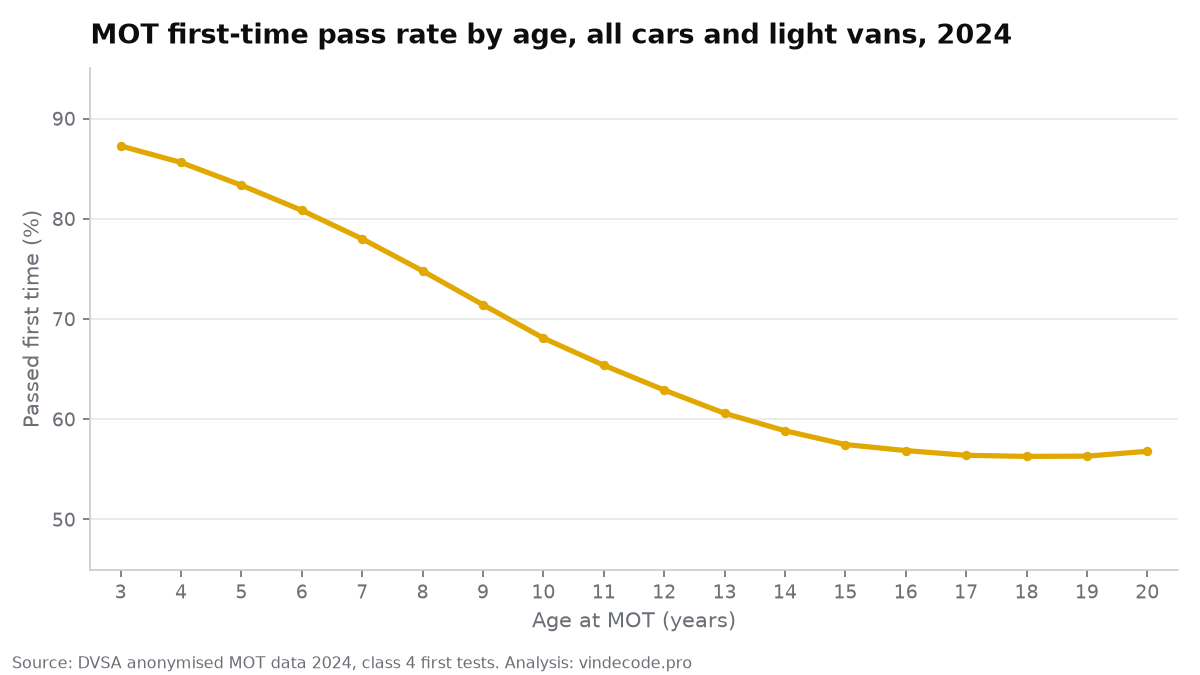
The flat stretch after sixteen is interesting. A likely reason is that the cars still on the road at that age are the ones owners have looked after, while neglected cars have already been scrapped. The data can't prove that, but median mileage barely rises after fifteen years either, which fits a group of lightly used, cared-for older cars.
MOT Pass Rate by Model, Compared at the Same Age
This table covers the 29 most-tested models in 2024. Read across a row to see how a model ages, or down a column to compare models fairly.
| Model | 2024 first MOTs | Pass at 3 to 5 years | Pass at 6 to 10 years | Pass at 11 to 15 years |
|---|---|---|---|---|
| Ford Fiesta | 1,330,754 | 85.9% | 68.8% | 56.8% |
| Ford Focus | 910,783 | 84.7% | 74.9% | 59.5% |
| Vauxhall Corsa | 820,147 | 80.2% | 66.3% | 57.3% |
| Volkswagen Golf | 815,026 | 88.5% | 82.8% | 65.3% |
| Vauxhall Astra | 630,620 | 83.2% | 72.7% | 61.1% |
| Volkswagen Polo | 590,713 | 81.7% | 72.6% | 58.2% |
| Nissan Qashqai | 555,248 | 86.2% | 73.0% | 48.3% |
| Toyota Yaris | 424,160 | 86.9% | 79.8% | 67.3% |
| Audi A3 | 388,441 | 88.1% | 81.5% | 64.9% |
| BMW 3 Series | 364,221 | 86.4% | 79.7% | 68.3% |
| Mercedes-Benz C-Class | 361,557 | 86.8% | 79.5% | 66.6% |
| Honda Jazz | 318,704 | 91.0% | 85.3% | 70.5% |
| Fiat 500 | 304,159 | 83.6% | 68.6% | 58.4% |
| Renault Clio | 299,107 | 75.8% | 60.2% | 48.1% |
| Ford Transit (van) | 289,963 | 74.7% | 66.7% | 51.1% |
| Nissan Juke | 274,483 | 84.1% | 68.6% | 54.3% |
| Honda Civic | 266,993 | 86.5% | 80.7% | 60.0% |
| Toyota Aygo | 260,763 | 88.0% | 80.8% | 62.0% |
| Kia Sportage | 257,426 | 83.7% | 75.8% | 59.4% |
| Ford Kuga | 253,897 | 85.3% | 79.2% | 62.2% |
| Volkswagen Transporter (van) | 253,699 | 80.2% | 74.1% | 64.8% |
| Audi A4 | 242,069 | 86.3% | 77.6% | 68.2% |
| Nissan Micra | 239,953 | 83.6% | 72.2% | 61.1% |
| Mercedes-Benz A-Class | 239,443 | 84.8% | 76.7% | 64.8% |
| Hyundai i10 | 233,437 | 83.1% | 76.3% | 62.3% |
| Skoda Fabia | 230,475 | 84.1% | 75.7% | 63.4% |
| Mercedes-Benz E-Class | 225,384 | 85.6% | 79.9% | 70.1% |
| Vauxhall Mokka | 218,513 | 79.7% | 68.1% | 61.5% |
| MINI Cooper | 214,181 | 87.9% | 83.2% | 71.3% |
| All cars and light vans | 32,601,605 | 85.2% | 74.8% | 61.5% |
Three patterns stand out.
The Honda Jazz wins at every age. It's the only model above 90% at three to five years, and it still passes 70.5% of the time at eleven to fifteen, nine points above the average.
The Nissan Qashqai ages badly. It starts above average at 86.2%, but by eleven to fifteen years it passes only 48.3% of the time, joint lowest with the Renault Clio (48.1%).
Raw pass rates mislead. The MINI Cooper's overall 2024 pass rate is 84.5%, but its median age at test was six years. The Ford Fiesta's is 64.8% at a median age of ten. Compared at the same age, the gap is real but much smaller.
We've looked in detail at the three most-tested models: the Ford Fiesta, the Vauxhall Corsa and the Volkswagen Golf.
What Fails Most Often
These are the share of all first-attempt tests with at least one failure in each group. A test can fail in more than one group.
| Failure group | Share of tests |
|---|---|
| Lamps, reflectors and electrical equipment | 10.9% |
| Suspension | 8.7% |
| Brakes | 6.7% |
| Tyres | 6.5% |
| Visibility (wipers, washers, windscreen) | 4.6% |
| Body, chassis and structure | 3.4% |
| Noise, emissions and leaks | 3.1% |
| Steering | 2.0% |
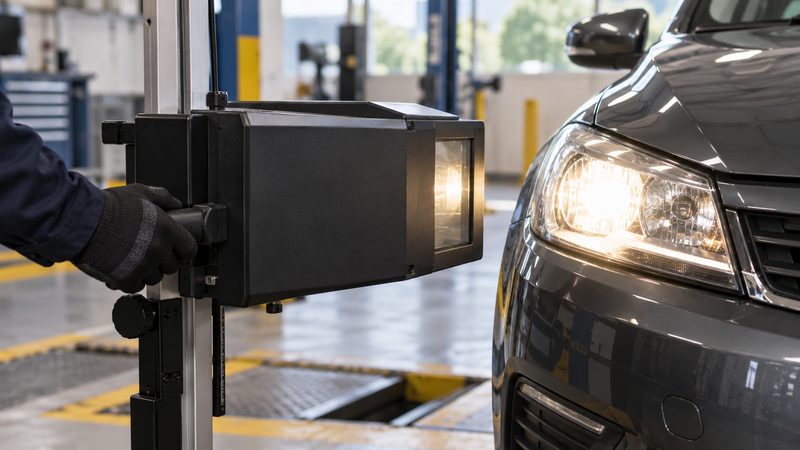
The single most common reason was a sidelight (position lamp) not working, on 2.5% of tests. Tyre tread below 1.6 mm (2.4%), wipers that don't clear the screen (2.1%) and a broken coil spring (2.1%) came next. A blown brake-light bulb failed 1.9% of tests, and an empty washer bottle 1.4%.
Many of these take minutes to check at home. Walk round the car with the lights on, get someone to press the brake pedal, top up the washer fluid and look at the tread before the test.
Using These Numbers When You Buy
A model's pass rate tells you what to expect from a typical example, not from the car in front of you. For that, use the free GOV.UK MOT history check with the registration number. It lists every past test, failure and advisory, and the recorded mileage each time.
Look for the same advisory repeating year after year, mileage that goes down between tests, and long gaps with no MOT. Then check the VIN on the car matches the V5C logbook. Our guide on where to find the VIN shows the usual locations.
How We Worked This Out
We used DVSA's 2024 anonymised MOT results and failure-item files. We kept class 4 vehicles and normal tests only, so retests and appeals are excluded. "Passed first time" means the test was recorded as a pass with no defects to fix. Passes after rectification count as not passing first time, because the car had a defect when it arrived.
Age is the time from the vehicle's first-use date to the test date, in whole years. Some test records appear more than once with conflicting details, mostly a different first-use date. We left out those 488,352 tests (1.5% of the total) rather than guess which version is right.
Model names are as DVLA records them. Older MINIs appear under a second model name, so the MINI Cooper row covers only cars recorded as "Cooper". The Transit and Transporter are vans; we've kept them because they're among the most-tested class 4 vehicles.
The data shows what happened at tests. It doesn't record how cars were driven or maintained, and it can't show why a model fails more often.
Frequently asked questions
What is the average MOT pass rate in the UK?
In our analysis of 2024 DVSA records, 71.8% of first-attempt MOTs on cars and light vans passed outright. Another 5.5% failed but had the defects fixed at the test centre during the visit, and 22.7% failed.
Which car has the best MOT pass rate?
Among the 29 most-tested models, the Honda Jazz had the highest first-time pass rate at every age band we checked: 91.0% at three to five years, 85.3% at six to ten and 70.5% at eleven to fifteen.
At what age do cars start failing MOTs more often?
The pass rate drops by roughly three points a year between ages five and twelve. It levels off at about 56% to 57% from sixteen years onwards.
Sources & official references
- DVSA: Anonymised MOT tests and resultsopen.data.dvsa.gov.uk
The 2024 results and failure-item files used for every figure on this page. Contains public sector information licensed under the Open Government Licence v3.0.
- GOV.UK: Getting an MOTgov.uk
When a vehicle needs its first MOT and what the test covers.
- GOV.UK: MOT inspection manual for cars and light commercial vehiclesgov.uk
The official definitions of minor, major and dangerous defects.